Stocks are one of the most talked-about investment types, yet many beginners find the concept confusing. News headlines about market highs and lows, unfamiliar terminology, and the fear of losing money can make stock investing feel more intimidating than it needs to be.
At its core, understanding stocks doesn’t require a finance degree. This guide breaks down what stocks are, how the stock market works, and what beginners should know before investing.
What Is a Stock?
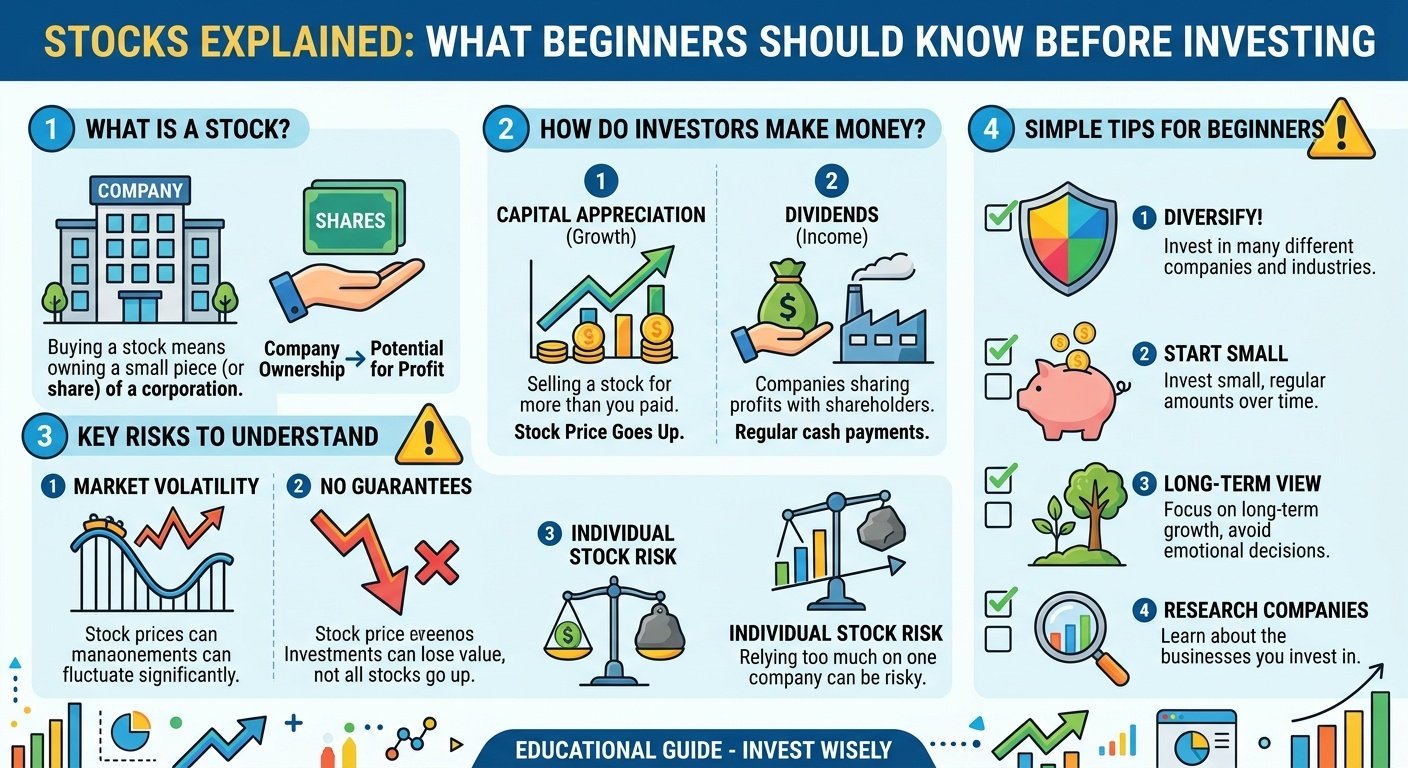
A stock represents a small piece of ownership in a company. When you buy a share of stock, you’re purchasing a fractional ownership stake in that business. As a shareholder, you may benefit if the company grows and becomes more valuable, but you also share in the risk if the company performs poorly.
Companies issue stock as a way to raise money for growth, operations, or other business needs, in exchange for giving investors partial ownership.
How Does the Stock Market Work?
The stock market is essentially a marketplace where shares of publicly traded companies are bought and sold. Instead of buying stock directly from the company, most individual investors buy and sell shares through a brokerage account, which connects to stock exchanges such as the New York Stock Exchange or Nasdaq.
Stock prices change constantly throughout the trading day based on supply and demand — influenced by factors like company performance, investor sentiment, economic news, and broader market trends. No single factor determines a stock’s price; it reflects the collective buying and selling decisions of all market participants.
Why Do Stock Prices Go Up and Down?
Stock prices fluctuate for many reasons, including:
- Company performance, such as earnings reports, revenue growth, or new product launches
- Economic conditions, like interest rates, inflation, or employment data
- Investor sentiment, which can be influenced by news, expectations, or broader market mood
- Industry trends, affecting multiple companies within the same sector
- Global events, which can create uncertainty or optimism across markets
Short-term price movements can be unpredictable and are often difficult to explain with a single cause. This is part of why long-term investing strategies are generally considered more reliable than attempting to predict short-term price swings.
Ways Stocks Can Generate Returns
Capital Appreciation
If a stock’s price increases after you purchase it, and you sell it at the higher price, the difference represents a capital gain. Of course, the reverse is also possible — if the price falls, selling would result in a loss.
Dividends
Some companies distribute a portion of their profits to shareholders in the form of dividends, typically paid quarterly. Not all companies pay dividends; some reinvest profits back into the business instead. Dividend payments aren’t guaranteed and can be reduced or eliminated if a company’s financial situation changes.
Types of Stocks
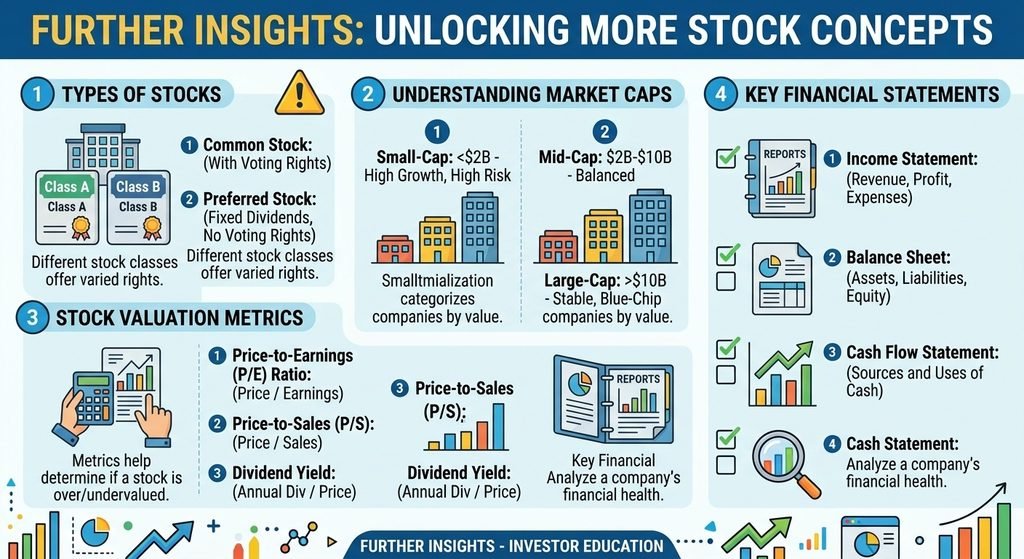
Common Stock
Common stock is the most typical type individual investors purchase. It usually comes with voting rights on certain company matters and the potential for dividends, though dividends aren’t guaranteed.
Preferred Stock
Preferred stock generally doesn’t come with voting rights but often has priority over common stock when it comes to receiving dividends or company assets in certain situations, such as bankruptcy.
Growth Stocks vs Value Stocks
Growth stocks are shares in companies expected to grow revenue or earnings faster than average, though they often trade at higher valuations and can be more volatile. Value stocks are shares that may be trading at a lower price relative to the company’s fundamentals, potentially offering more stability, though growth may be slower.
Individual Stocks vs Diversified Funds
Beginners often face a choice between buying individual stocks or investing through diversified funds like index funds or ETFs.
Individual stocks allow you to invest directly in specific companies you believe in, but they concentrate risk — if that company performs poorly, your investment is directly affected.
Diversified funds spread your money across many companies at once, reducing the impact of any single company’s poor performance, though you also won’t benefit as much if one company performs exceptionally well.
For many beginners, starting with diversified funds and gradually learning about individual stock analysis, if interested, is a commonly suggested approach — though this depends on personal goals and risk tolerance.
Key Risks to Understand
Market risk. Stock prices can decline due to broader market conditions, even for well-run companies.
Company-specific risk. Individual companies can underperform or fail due to poor management, competition, or changing industry conditions.
Volatility. Stock prices can fluctuate significantly in short periods, which can be unsettling, especially for new investors.
No guaranteed returns. Unlike a savings account with a stated interest rate, stocks offer no guaranteed return, and it’s possible to lose some or all of your investment.
Practical Tips for Beginners Considering Stocks
- Start with research, understanding what you’re investing in rather than following trends or hype.
- Consider your time horizon. Stocks are generally more appropriate for long-term goals, since short-term price swings can be significant.
- Avoid investing money you’ll need soon, since you may be forced to sell at a loss if you need the funds during a downturn.
- Think about diversification rather than concentrating your investments in a single stock or sector.
- Avoid emotional decision-making, such as panic-selling during downturns or chasing stocks after rapid price increases.
Common Mistakes Beginners Make With Stocks
- Investing based on hype or social media trends without independent research
- Putting a large portion of savings into a single stock
- Checking stock prices excessively and reacting emotionally to short-term movements
- Ignoring fees and taxes associated with buying and selling frequently
- Expecting guaranteed or fast returns
Key Takeaways
- A stock represents partial ownership in a company, and its value can rise or fall based on many factors.
- Stocks can generate returns through capital appreciation and, in some cases, dividends.
- Individual stocks carry more concentrated risk than diversified funds like index funds or ETFs.
- Stock prices can be volatile in the short term, making stocks generally more suitable for long-term goals.
- No investment, including stocks, offers guaranteed returns.
Conclusion
Stocks represent one of the most well-known ways to invest, offering the potential for long-term growth alongside real risk. Understanding how stocks work, what drives their prices, and the difference between individual stocks and diversified funds can help beginners make more informed decisions. As with all investing, patience, diversification, and a long-term perspective tend to serve investors better than chasing short-term trends.