When people think about investing, stocks usually come to mind first. But bonds are another major building block of many investment portfolios, often playing a very different role than stocks. While stocks represent ownership in a company, bonds represent a loan — and that fundamental difference shapes how they behave, how much risk they carry, and why investors choose to hold them.
This guide explains what bonds are, how they work, the common types available, and why they’re often used alongside stocks in a balanced investment approach.
What Is a Bond?
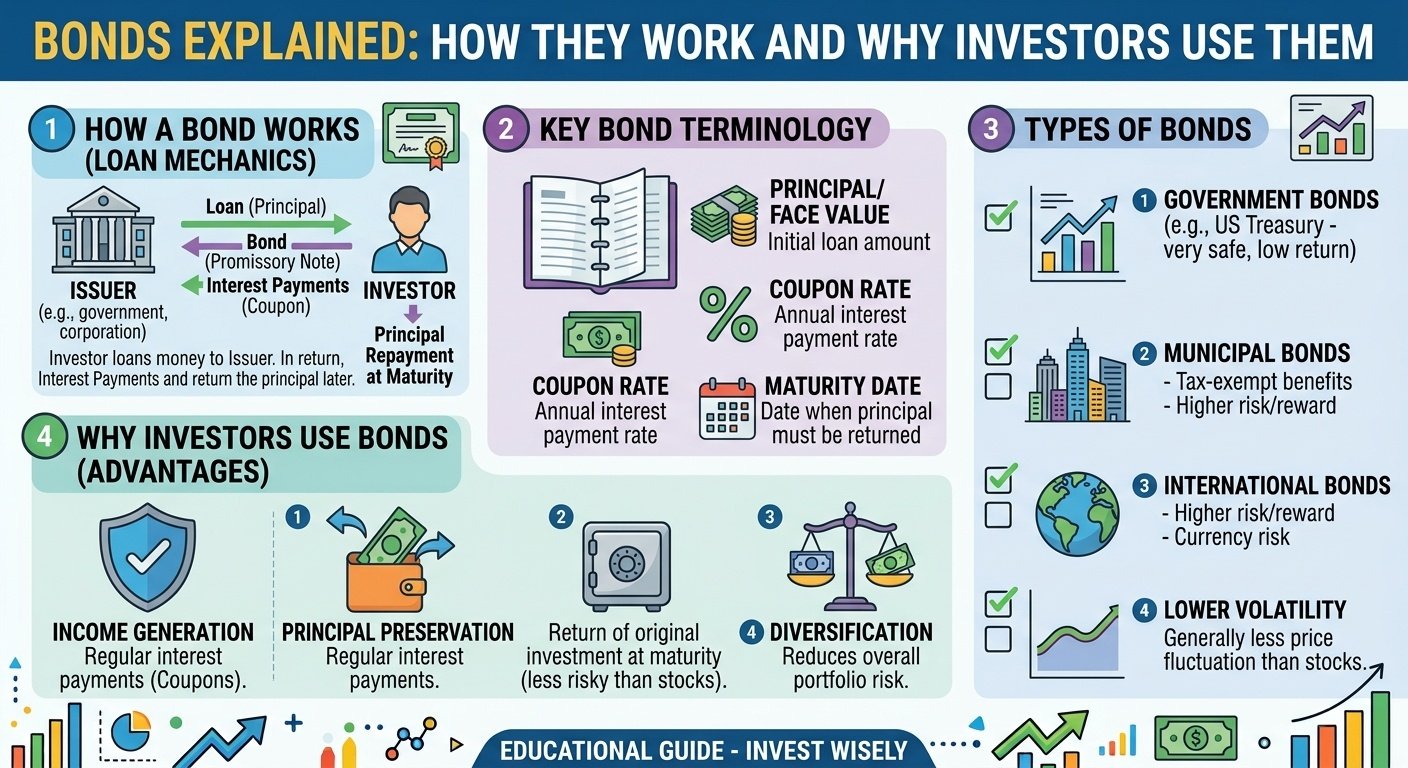
A bond is essentially a loan made by an investor to a borrower, typically a government or a company. When you buy a bond, you’re lending money to the issuer in exchange for two things:
- Regular interest payments over a set period (often called “coupon payments”)
- Return of the original loan amount, known as the “face value” or “principal,” at the bond’s maturity date
Bonds have a defined term, called the maturity, which can range from a few months to several decades depending on the type of bond.
How Bonds Work: A Simple Example
Imagine a company issues a bond with a face value of $1,000, an interest rate (coupon rate) of 5%, and a 10-year maturity. As the bondholder, you would typically receive $50 per year in interest payments (5% of $1,000) for 10 years, and then receive the original $1,000 back at maturity, assuming the issuer doesn’t default.
This is a simplified example — actual bond structures can vary, including differences in payment frequency, interest rate type, and other features.
Why Do Governments and Companies Issue Bonds?
Governments issue bonds to fund public projects, cover budget needs, or manage national debt. Companies issue bonds to raise money for expansion, operations, or other business needs, often as an alternative to taking out a traditional loan or issuing more stock.
Common Types of Bonds
Government Bonds
Issued by national governments, these are often considered among the lower-risk bond options, particularly for financially stable countries, since the government has the ability to tax and generate revenue to meet its obligations. That said, no investment is entirely without risk.
Municipal Bonds
Issued by state or local governments, these bonds often fund public projects like schools, roads, or infrastructure. In some countries, they may come with specific tax advantages, though rules vary and should be verified with a current, reliable source.
Corporate Bonds
Issued by companies, corporate bonds generally carry more risk than government bonds, since companies are more likely to face financial difficulty than a stable government. In exchange for this added risk, corporate bonds often offer higher interest rates.
High-Yield (or “Junk”) Bonds
These are corporate bonds issued by companies with lower credit ratings, meaning a higher perceived risk of default. To compensate investors for this added risk, high-yield bonds typically offer higher interest rates than investment-grade bonds.
Understanding Bond Ratings
Credit rating agencies assess the financial strength of bond issuers and assign ratings that reflect the perceived risk of default. Generally:
- Investment-grade bonds are considered lower risk, issued by financially stable governments or companies
- High-yield (junk) bonds are considered higher risk, offering higher potential returns to compensate
These ratings can change over time as an issuer’s financial situation evolves, so it’s worth checking current ratings from a reliable source before investing.
Bond Prices and Interest Rates
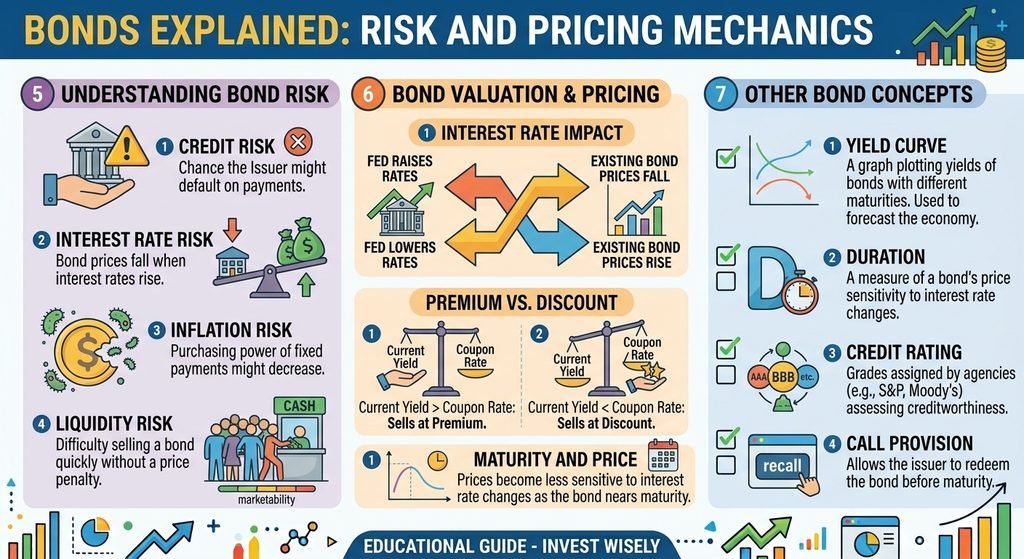
One important concept for bond investors is the relationship between bond prices and interest rates: they generally move in opposite directions.
When interest rates rise, existing bonds with lower rates become less attractive compared to new bonds issued at higher rates, causing existing bond prices to fall. When interest rates fall, existing bonds with higher rates become more attractive, often causing their prices to rise.
This mainly affects investors who sell bonds before maturity. If you hold a bond to maturity, you generally receive the face value back regardless of these price fluctuations, assuming the issuer doesn’t default.
Bonds vs Stocks: Key Differences
| Feature | Bonds | Stocks |
|---|---|---|
| What you own | A loan to the issuer | Partial ownership in a company |
| Typical risk level | Generally lower | Generally higher |
| Typical return potential | Generally more modest | Generally higher, but more variable |
| Income type | Regular interest payments | Potential dividends (not guaranteed) |
| Priority in bankruptcy | Bondholders generally paid before shareholders | Shareholders paid last |
This is a general comparison — actual risk and return can vary significantly depending on the specific bond or stock involved.
Why Investors Include Bonds in a Portfolio
Income generation. Bonds provide relatively predictable interest payments, which can appeal to investors seeking steady income.
Lower volatility. Bonds, particularly government and investment-grade bonds, generally experience less dramatic price swings than stocks.
Diversification. Because bonds and stocks don’t always move in the same direction, holding both can help balance a portfolio’s overall risk.
Capital preservation. Especially for investors nearing a financial goal, like retirement, bonds can help preserve accumulated wealth with generally lower risk than stocks.
Risks of Bond Investing
Bonds are often considered lower-risk than stocks, but they aren’t risk-free. Key risks include:
Interest rate risk. Rising interest rates can cause bond prices to fall if sold before maturity.
Credit or default risk. The issuer may be unable to make interest payments or repay the principal, particularly relevant for lower-rated bonds.
Inflation risk. If inflation rises faster than a bond’s fixed interest rate, the real purchasing power of those payments can decline over time.
Liquidity risk. Some bonds may be harder to sell quickly at a fair price compared to more actively traded investments.
How Beginners Can Access Bonds
Individual investors can typically access bonds through:
- Direct purchase of government bonds through official government platforms
- Bond mutual funds or bond ETFs, which offer diversified exposure to many bonds at once
- Brokerage accounts, which may allow direct purchase of individual corporate or municipal bonds
For beginners, bond funds are often considered a simpler starting point, since they offer built-in diversification without needing to evaluate individual bond issuers.
Key Takeaways
- A bond represents a loan from an investor to a government or company, paid back with interest over time.
- Bonds are generally considered lower-risk than stocks, though risk varies significantly by type and issuer.
- Bond prices and interest rates typically move in opposite directions.
- Bonds are often used to generate income, reduce portfolio volatility, and provide diversification alongside stocks.
- Bond investing still carries risks, including interest rate risk, credit risk, and inflation risk.
Conclusion
Bonds play a distinct role in the investing world, offering a way to earn relatively predictable income while generally carrying less risk than stocks. Understanding how bonds work — including the relationship between prices and interest rates, and the different types available — can help investors decide how bonds might fit into a broader, diversified investment strategy. As with any investment, it’s important to understand the specific risks involved before committing money.