Building a diversified investment portfolio from scratch — picking individual stocks and bonds, researching companies, and balancing risk — can feel like a full-time job. Mutual funds offer a way around that complexity by pooling money from many investors and using it to purchase a diversified mix of investments, managed by a professional fund manager or designed to track a specific market index.
For many beginners, mutual funds serve as an accessible entry point into investing. This guide explains what mutual funds are, how they work, the different types available, and what to consider before investing in one.
What Is a Mutual Fund?
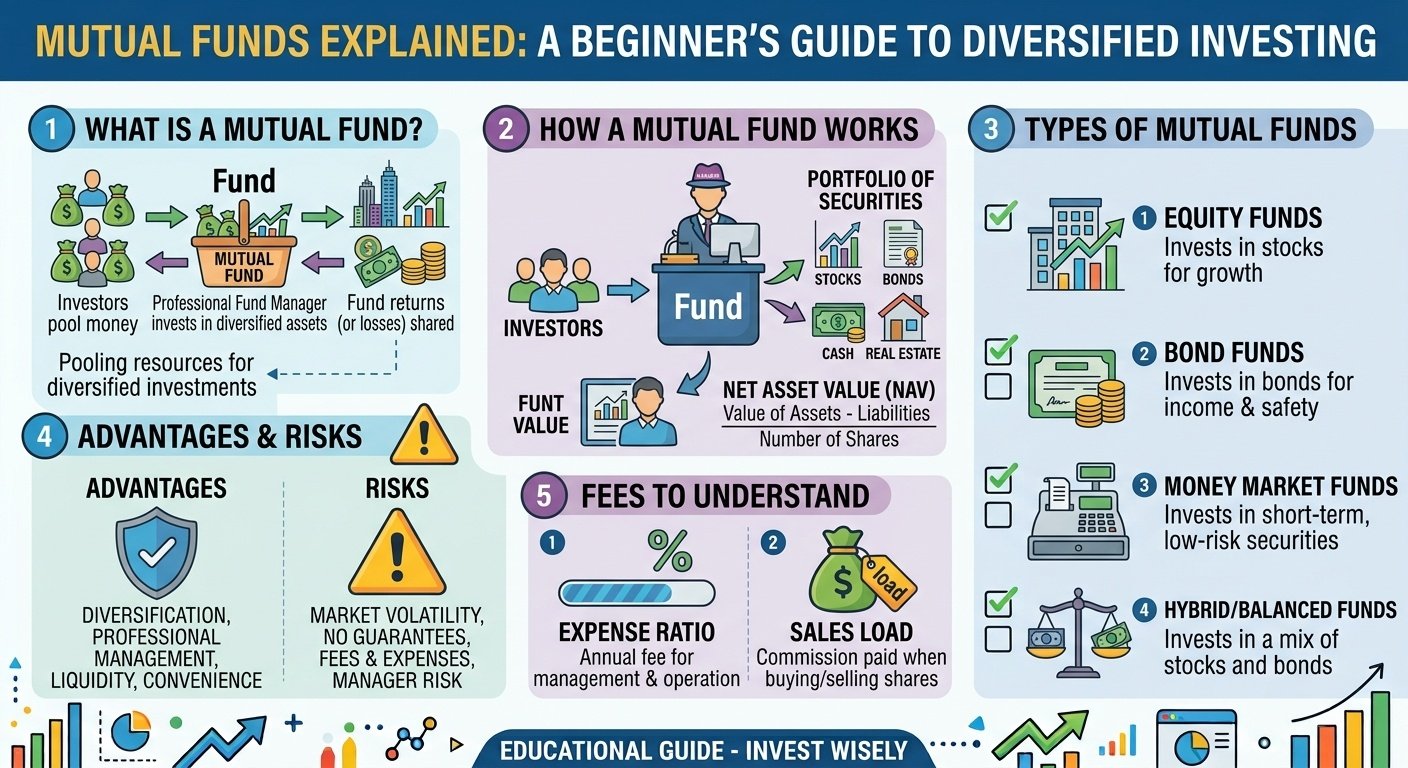
A mutual fund is an investment vehicle that pools money from many investors to purchase a diversified portfolio of assets, such as stocks, bonds, or a combination of both. When you invest in a mutual fund, you’re buying shares of the fund itself, and your money is combined with other investors’ contributions to purchase the fund’s underlying holdings.
Instead of trying to pick individual investments yourself, you’re relying on the fund’s strategy — whether that’s active management by a professional or a passive approach that tracks a market index — to determine what the fund holds.
How Do Mutual Funds Work?
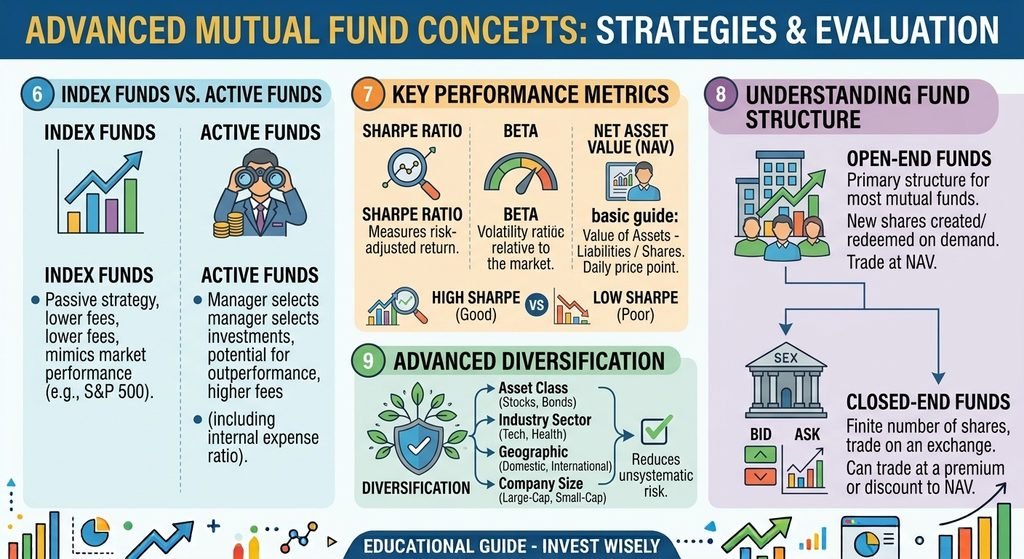
When you invest in a mutual fund, your money buys shares at the fund’s Net Asset Value (NAV), which represents the value of one share of the fund’s total holdings. Unlike stocks, which trade throughout the day at fluctuating prices, mutual fund shares are typically priced once per day, after the market closes.
As the value of the fund’s underlying investments changes, the NAV changes too, which affects the value of your shares. Some mutual funds also distribute income, such as dividends or interest earned by the fund’s holdings, to shareholders periodically.
Active vs Passive Mutual Funds
Actively Managed Funds
These funds are run by professional fund managers who make decisions about which investments to buy and sell, aiming to outperform a specific benchmark or market index. Active management typically comes with higher fees, since it requires ongoing research, analysis, and decision-making.
Passively Managed (Index) Funds
These funds aim to match the performance of a specific market index, such as a broad stock market index, rather than trying to outperform it. Because they don’t require active decision-making about individual holdings, index funds typically have lower fees than actively managed funds.
Over long periods, many actively managed funds have struggled to consistently outperform their benchmark index after accounting for fees, which is one reason index funds have grown in popularity among long-term investors. That said, results vary, and past performance doesn’t guarantee future outcomes.
Common Types of Mutual Funds
Stock (Equity) Funds
These funds primarily hold stocks and are generally considered higher-risk, higher-potential-return investments, suitable for investors with a longer time horizon.
Bond Funds
These funds primarily hold bonds and are generally considered lower-risk than stock funds, though risk varies depending on the specific bonds held within the fund.
Balanced (or Hybrid) Funds
These funds hold a mix of stocks and bonds, aiming to balance growth potential with reduced volatility compared to a pure stock fund.
Money Market Funds
These funds invest in low-risk, short-term instruments and aim to provide stability and liquidity, though they generally offer more modest returns compared to stock or bond funds.
Target-Date Funds
These funds automatically adjust their mix of investments over time, typically becoming more conservative as a specified target date (often retirement) approaches. They’re designed to simplify long-term investing by handling asset allocation decisions automatically.
Sector or Specialty Funds
These funds focus on a specific industry or theme, such as technology or healthcare. They tend to carry more concentrated risk than broadly diversified funds, since performance depends heavily on that particular sector.
Understanding Mutual Fund Fees
Mutual funds charge fees that can impact your overall returns, so it’s important to understand them before investing.
Expense ratio. This is an annual fee, expressed as a percentage of your investment, that covers the fund’s operating costs. Even small differences in expense ratios can meaningfully affect returns over long periods.
Sales loads. Some funds charge a fee when you buy (front-end load) or sell (back-end load) shares. Many funds, particularly no-load funds, don’t charge this type of fee.
Other fees. Some funds may charge additional fees for early redemption or account maintenance, so it’s worth reviewing a fund’s official documentation carefully.
Mutual Funds vs ETFs
Mutual funds and exchange-traded funds (ETFs) share similarities — both offer diversified exposure to a basket of investments — but they differ in a few key ways:
| Feature | Mutual Funds | ETFs |
|---|---|---|
| Pricing | Once daily, after market close | Throughout the trading day |
| Minimum investment | Sometimes required | Often just the price of one share |
| Typical fees | Can be higher, especially if actively managed | Often lower, especially for passive ETFs |
| Trading flexibility | Limited to end-of-day pricing | Can be bought/sold like a stock during market hours |
Neither option is universally better — the right choice depends on your goals, investment amount, and preferences.
Benefits of Mutual Funds for Beginners
Built-in diversification. A single mutual fund can provide exposure to dozens or even hundreds of individual securities, reducing the impact of any one investment performing poorly.
Professional management (for active funds). Beginners without the time or expertise to research individual investments can rely on a fund manager’s expertise, though this comes at a cost and doesn’t guarantee better performance.
Accessibility. Many mutual funds allow beginners to start investing with relatively modest amounts, and some offer automatic investment plans.
Simplicity. Rather than managing a portfolio of individual stocks and bonds, investors can rely on a single fund (or a small number of funds) to achieve diversification.
Risks to Understand
Mutual funds don’t eliminate investment risk — they primarily help manage it through diversification. Risks include:
- The value of the fund can still decline, particularly stock and bond funds during market downturns
- Actively managed funds may underperform their benchmark, even after charging higher fees
- Past performance of a fund doesn’t guarantee future results
- Fees, even seemingly small ones, can meaningfully reduce long-term returns
Common Mistakes to Avoid
- Choosing a fund based solely on strong recent past performance
- Ignoring the expense ratio and its long-term impact on returns
- Not understanding what the fund actually invests in
- Overlapping multiple funds that hold very similar investments, reducing actual diversification
- Investing in a fund that doesn’t match your risk tolerance or time horizon
Key Takeaways
- A mutual fund pools money from many investors to purchase a diversified portfolio of stocks, bonds, or other assets.
- Funds can be actively managed, aiming to outperform the market, or passively managed, aiming to track a market index.
- Fees, especially the expense ratio, can significantly affect long-term returns and should be carefully considered.
- Mutual funds offer diversification and simplicity, making them a common starting point for beginner investors.
- Like all investments, mutual funds carry risk and don’t guarantee returns.
Conclusion
Mutual funds offer a practical way for beginners to access diversified investing without needing to individually select and manage a portfolio of stocks and bonds. Understanding the difference between active and passive management, paying attention to fees, and choosing funds that align with your goals and risk tolerance are key steps toward using mutual funds effectively as part of a long-term investment strategy.