One of the most fundamental concepts in investing is the relationship between risk and return. It shows up in nearly every investment decision, whether you’re choosing between a savings account and a stock fund, or deciding how to allocate money across different types of investments. Understanding this relationship can help you make more informed choices and set realistic expectations about what your investments might do.
This article explains what risk and return mean in an investing context, why they’re connected, and how to think about finding the right balance for your own situation.
What Is “Return” in Investing?
Return refers to the gain or loss generated by an investment over a specific period, usually expressed as a percentage. Returns can come from:
- Capital appreciation, when an investment’s value increases
- Income, such as interest payments from bonds or dividends from stocks
Returns can be positive (a gain) or negative (a loss), and past returns don’t guarantee what an investment will do in the future.
What Is “Risk” in Investing?
Risk generally refers to the uncertainty surrounding an investment’s returns — specifically, the possibility that the actual outcome will differ from what was expected, including the possibility of losing money. Different types of investments carry different levels and types of risk, including:
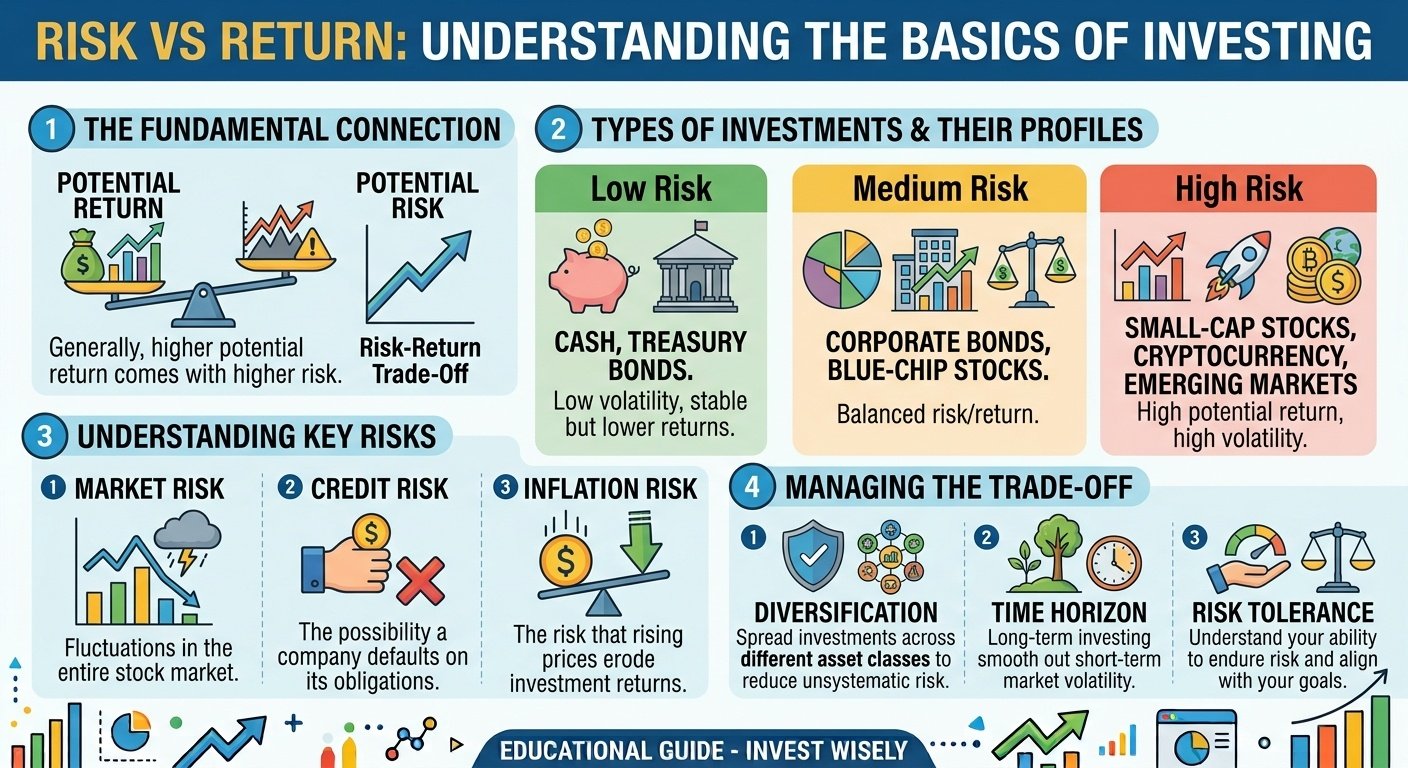
Market risk. The risk that overall market conditions cause an investment’s value to decline, regardless of how well a specific company or asset is performing individually.
Company-specific risk. The risk tied to an individual company’s performance, management decisions, or competitive position.
Interest rate risk. Particularly relevant for bonds, this is the risk that changing interest rates affect an investment’s value.
Inflation risk. The risk that returns won’t keep pace with rising prices, eroding purchasing power over time.
Liquidity risk. The risk that an investment can’t be easily sold or converted to cash without a significant loss in value.
The Basic Risk-Return Relationship
In general, investments with higher potential returns tend to carry higher risk, while investments with lower risk tend to offer more modest potential returns. This relationship exists because investors generally require the possibility of higher returns to compensate for taking on additional risk. If a low-risk investment offered the same potential return as a high-risk one, few investors would choose the riskier option.
This doesn’t mean higher risk always leads to higher actual returns — it simply reflects the greater uncertainty and wider range of possible outcomes, including the possibility of significant losses.
A Simple Illustration
Consider three hypothetical types of investments:
- A savings account offers a low, relatively stable and predictable return, with minimal risk of losing the principal (particularly when covered by relevant deposit insurance, where applicable).
- A government bond offers a somewhat higher potential return than a typical savings account, with relatively low risk, assuming the issuing government remains financially stable.
- A stock in a growing company offers potentially higher returns than the bond, but with meaningfully more risk, including the possibility of significant losses if the company underperforms.
This is a simplified illustration, and actual risk and return levels vary significantly within each category depending on the specific investment.
Why Understanding This Relationship Matters
It sets realistic expectations. Understanding the risk-return relationship helps you avoid assuming you can find an investment with high returns and no meaningful risk — such opportunities are generally either misunderstood or, in some cases, signs of fraudulent schemes.
It informs diversification decisions. Since different investments carry different risk-return profiles, combining them can help balance overall portfolio risk.
It helps match investments to goals. Short-term goals may call for lower-risk investments to protect the money you’ll need soon, while long-term goals may allow room for higher-risk, higher-potential-return investments.
Understanding Your Own Risk Tolerance
Risk tolerance refers to your personal ability and willingness to withstand investment losses, both financially and emotionally. It’s shaped by factors such as:
- Time horizon. A longer time horizon generally allows more room to recover from short-term losses.
- Financial situation. Your income, savings, and other financial obligations affect how much risk you can reasonably take on.
- Emotional comfort with volatility. Some investors can watch their investments decline in value without panicking, while others find this stressful, which can lead to poor decision-making during downturns.
- Investment goals. The purpose of the money — retirement decades away versus a home down payment in two years — affects how much risk is appropriate.
There’s no universally “correct” risk tolerance. The goal is to choose investments that align with your specific financial situation, time horizon, and comfort level.
Risk Capacity vs Risk Tolerance
It’s worth distinguishing between two related but different concepts:
Risk tolerance is about your emotional and psychological comfort with risk and potential losses.
Risk capacity is about your actual financial ability to absorb losses without jeopardizing your financial stability or goals.
Someone might feel emotionally comfortable with high risk but have limited actual capacity to absorb losses, for example, if they’re relying on the money for an upcoming expense. In these cases, it’s generally wise to let risk capacity guide decisions more than emotional comfort alone.
How Diversification Relates to Risk and Return
Diversification — spreading investments across different assets, sectors, or asset classes — is one of the primary tools investors use to manage risk without necessarily sacrificing all potential return. While diversification doesn’t eliminate risk entirely, it can help reduce the impact of any single investment performing poorly, since different investments often respond differently to the same economic conditions.
Common Misunderstandings About Risk and Return
“Higher risk always means higher return.” This isn’t accurate. Higher risk means a wider range of possible outcomes, including the possibility of greater losses, not a guarantee of greater gains.
“Low risk means no risk.” Even relatively low-risk investments, like government bonds or savings accounts, carry some risk, such as inflation risk or, in rare cases, issuer default.
“Past returns predict future returns.” An investment’s historical performance doesn’t guarantee how it will perform going forward, since market conditions and other factors change over time.
“I can avoid risk entirely and still grow my money significantly.” Avoiding risk generally means accepting more modest potential returns, and in some cases, may not keep pace with inflation over time.
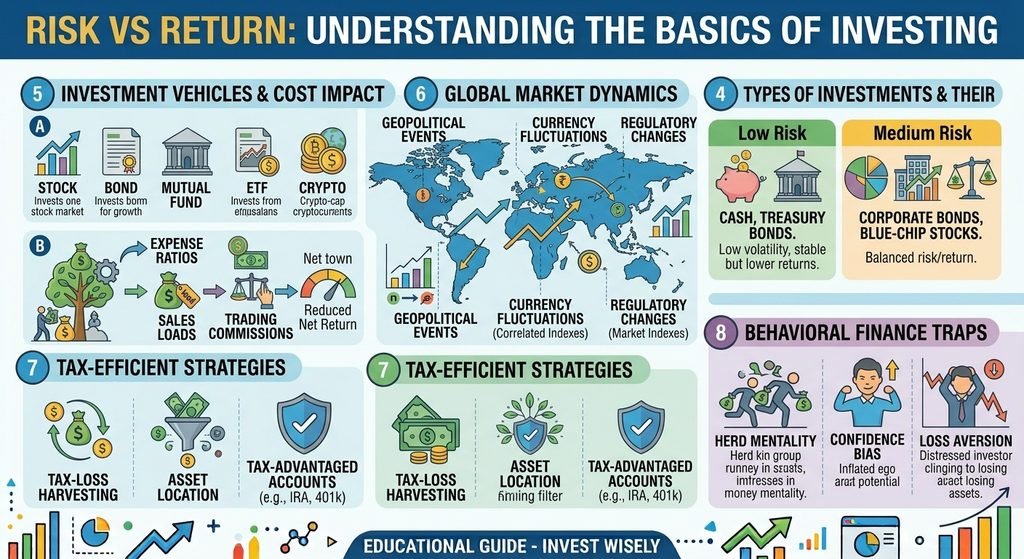
Table: General Risk-Return Spectrum
| Investment Type | General Risk Level | General Return Potential |
|---|---|---|
| Savings accounts | Low | Low |
| Government bonds | Low to moderate | Low to moderate |
| Corporate bonds | Moderate | Moderate |
| Diversified stock funds | Moderate to high | Moderate to high |
| Individual stocks | High | High (but variable) |
This table reflects general tendencies, not guarantees. Actual risk and return levels vary by specific investment and market conditions.
Key Takeaways
- Return refers to the gain or loss on an investment; risk refers to the uncertainty surrounding that outcome, including potential losses.
- Generally, higher potential returns come with higher risk, though higher risk doesn’t guarantee higher actual returns.
- Risk tolerance (emotional comfort) and risk capacity (financial ability to absorb losses) are related but different concepts worth considering separately.
- Diversification can help manage risk without necessarily eliminating potential returns.
- No investment is entirely free of risk, even relatively conservative options like savings accounts or government bonds.
Conclusion
Understanding the relationship between risk and return is one of the most valuable lessons in investing. Higher potential returns generally come with higher risk, and there’s no way to entirely escape this trade-off while still pursuing meaningful growth. By understanding your own risk tolerance and risk capacity, diversifying appropriately, and setting realistic expectations, you can make investment decisions that align with both your financial goals and your ability to stay the course during market ups and downs.