You’ve likely noticed it yourself: groceries, gas, rent, or everyday goods seem to cost more than they used to. This gradual rise in prices is called inflation, and it’s one of the most important economic concepts to understand, since it affects nearly every part of your financial life — from the value of your savings to the real return on your investments.
This guide explains what inflation is, what causes it, how it’s measured, and what it means for your everyday financial decisions.
What Is Inflation?
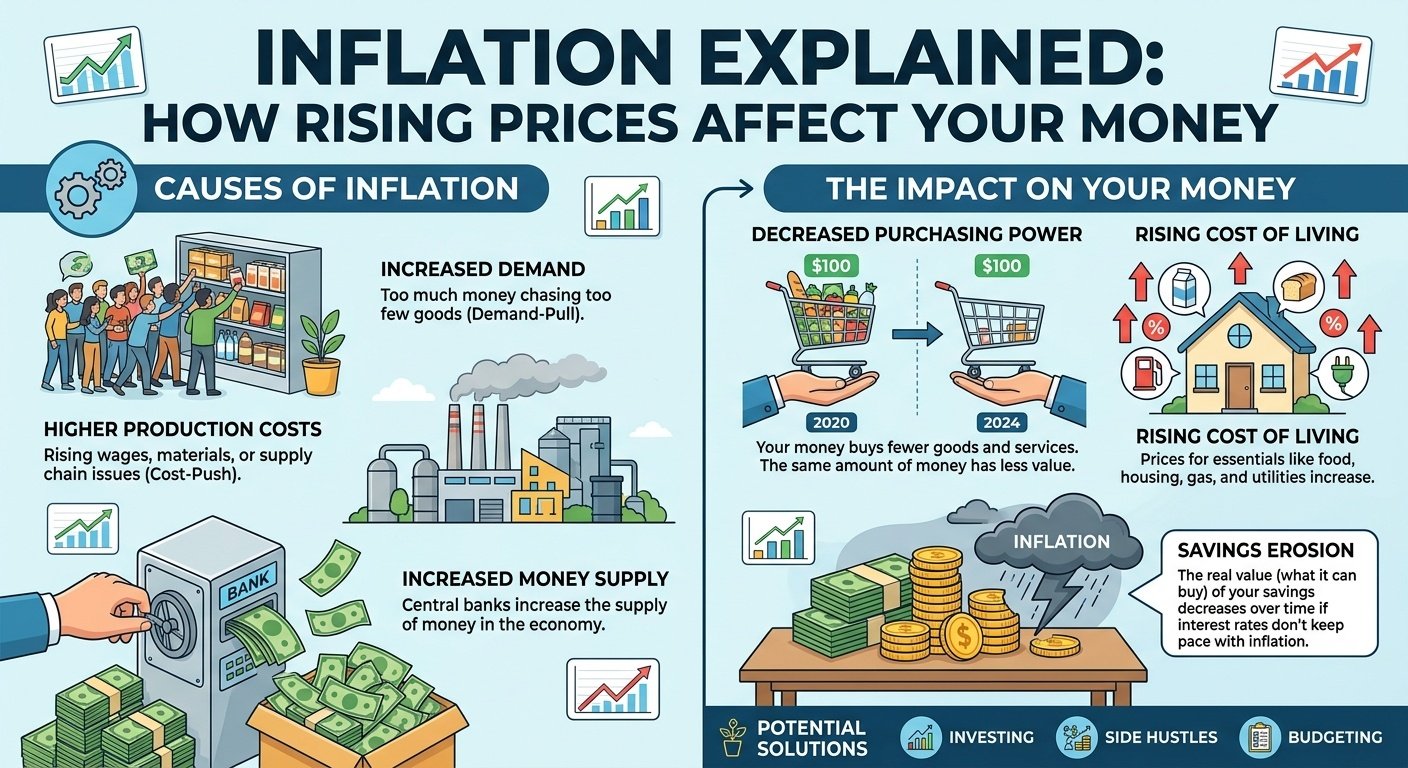
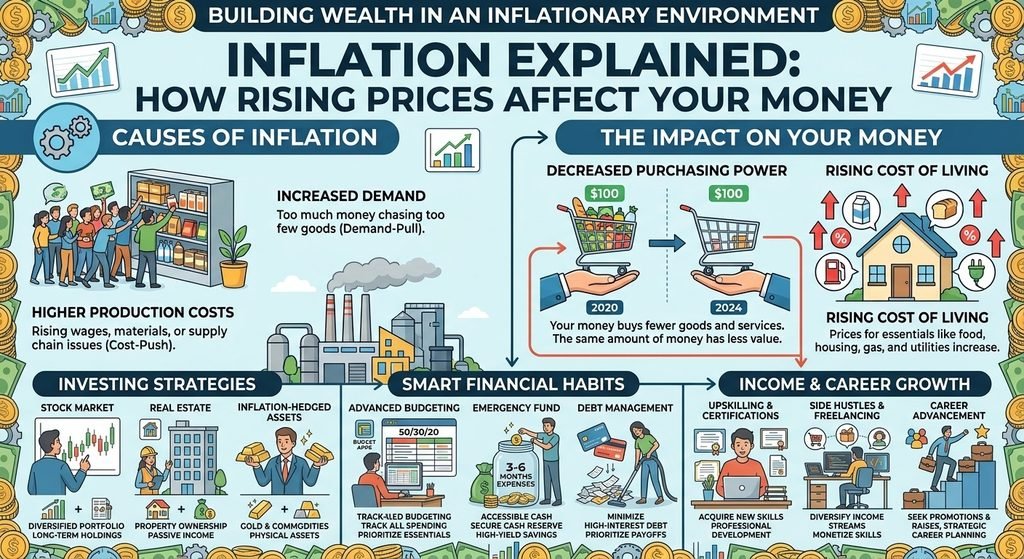
Inflation refers to the general increase in prices of goods and services over time, which results in a decrease in the purchasing power of money. In simple terms, as inflation rises, each unit of currency buys a little less than it did before.
For example, if a basket of groceries cost a certain amount a year ago and costs noticeably more today for the same items, that reflects inflation’s effect on purchasing power.
Inflation is typically measured as an annual percentage rate, reflecting how much average prices have risen compared to the previous year. Since inflation rates change over time and vary by country, it’s important to check current figures from a reliable source, such as a government statistics agency, rather than relying on outdated numbers.
What Causes Inflation?
Inflation can result from several different factors, and economists often categorize the main causes as follows:
Demand-Pull Inflation
This occurs when overall demand for goods and services in an economy grows faster than the supply available to meet it, pushing prices upward. This can happen during periods of strong economic growth, low unemployment, or increased consumer spending.
Cost-Push Inflation
This occurs when the cost of producing goods and services rises — due to factors like higher raw material costs, labor costs, or supply chain disruptions — and businesses pass these increased costs on to consumers through higher prices.
Monetary Factors
Changes in the money supply and monetary policy, set by a country’s central bank, can also influence inflation. Generally, if the money supply grows significantly faster than the economy’s output of goods and services, it can contribute to inflationary pressure, though the relationship is complex and influenced by many other factors.
Supply Chain and External Factors
Disruptions to supply chains, changes in energy prices, or other global economic events can also contribute to inflation, sometimes suddenly and independent of typical demand or monetary factors.
How Is Inflation Measured?
Inflation is commonly measured using indexes that track the price of a representative basket of goods and services over time, such as a Consumer Price Index (CPI). Government statistical agencies typically calculate and publish these figures regularly. Since exact methodologies and current rates vary by country and change over time, checking official, current sources is the most reliable way to understand inflation in your specific location.
How Inflation Affects Your Money
Reduced Purchasing Power
The most direct effect of inflation is that your money buys less over time. If your income doesn’t increase at a similar pace, your standard of living can effectively decline, even if your nominal income stays the same.
Impact on Savings
Money held in a low-interest savings account can lose purchasing power over time if the account’s interest rate is lower than the inflation rate. This is sometimes referred to as a “negative real return,” where the nominal (stated) interest rate doesn’t keep pace with rising prices.
Impact on Investments
Inflation affects different investments differently. Some assets, like certain stocks or real estate, have historically had some potential to outpace inflation over long periods, though this isn’t guaranteed. Fixed-rate bonds can be more directly affected, since their fixed interest payments may lose purchasing power if inflation rises unexpectedly.
Impact on Debt
Interestingly, inflation can have a mixed effect on debt. If you have a fixed-rate loan, inflation doesn’t increase your required payment amount, meaning you’re technically repaying the loan with money that has somewhat less purchasing power than when you borrowed it. However, this doesn’t mean debt becomes advantageous during inflation — it simply illustrates one of inflation’s more nuanced effects.
Impact on Wages
Wages don’t always rise at the same pace as inflation, which can affect real purchasing power even for people who receive regular raises. Some employment sectors and contracts include cost-of-living adjustments intended to help wages keep pace with inflation, though this isn’t universal.
Inflation vs Deflation
While inflation refers to rising prices, deflation refers to a general decrease in prices over time. While falling prices might sound beneficial, significant deflation can also create economic challenges, such as reduced business revenue, layoffs, and decreased economic activity, since consumers may delay purchases expecting prices to fall further. Most economies generally aim for a low, stable, and predictable rate of inflation rather than zero inflation or deflation.
How to Think About Inflation in Your Financial Planning
Consider inflation when setting savings goals. A long-term savings goal, like retirement, should generally account for the fact that prices will likely be higher in the future than they are today.
Understand “real” vs “nominal” returns. A nominal return is the stated percentage gain on an investment, while a real return accounts for inflation’s effect, showing your actual increase in purchasing power. When evaluating long-term investment performance, considering the real return offers a more accurate picture.
Avoid keeping excessive cash in low-yield accounts long-term. While cash and cash-equivalents are useful for short-term needs and emergency funds, holding large amounts of cash for long-term goals may result in a loss of purchasing power over time due to inflation.
Diversify your investments. Different asset types respond differently to inflation, so a diversified investment approach can help manage this risk, though it doesn’t eliminate it.
Common Misunderstandings About Inflation
“Inflation is always bad.” Low, stable inflation is generally considered a normal part of a healthy economy and is often targeted by central banks. It’s typically high or unpredictable inflation that creates more significant economic challenges.
“Prices only go up during high inflation periods.” Prices generally trend upward over time even during periods of relatively low inflation — the difference lies in the pace of that increase.
“Inflation affects everyone equally.” In reality, inflation can affect different income levels, spending patterns, and regions differently, since the basket of goods and services people rely on can vary significantly.
Key Takeaways
- Inflation refers to the general rise in prices over time, which reduces the purchasing power of money.
- Common causes include demand-pull factors, cost-push factors, monetary policy, and supply chain disruptions.
- Inflation can erode the value of cash savings, particularly when account interest rates don’t keep pace with inflation.
- Understanding “real” versus “nominal” returns helps evaluate whether your investments are truly growing your purchasing power.
- Because inflation rates change over time, it’s important to check current data from official sources rather than relying on outdated figures.
Conclusion
Inflation is a normal, ongoing part of most economies, but understanding how it works can help you make more informed financial decisions. From evaluating your savings strategy to understanding the real return on your investments, factoring inflation into your financial planning helps ensure your money maintains its purchasing power over time, rather than quietly losing value in the background.