Managing money without clear goals is a bit like starting a road trip without a destination — you might make progress, but it’s hard to know if you’re actually heading somewhere meaningful. Financial goals give your money decisions purpose and direction, turning vague intentions like “save more” into specific, achievable targets.
This guide explains how to set effective financial goals, the difference between short-term and long-term goals, and practical strategies for staying on track.
Why Financial Goals Matter
Clear financial goals offer several benefits:
- They give your budgeting and saving decisions a clear purpose
- They make it easier to measure progress and stay motivated
- They help you prioritize when money is limited and choices need to be made
- They reduce the likelihood of impulsive or reactive financial decisions
Without specific goals, it’s easy for extra money to get absorbed into everyday spending, rather than being directed toward something meaningful.
Categories of Financial Goals
Financial goals are often grouped by timeframe, since this affects how you save for them and what type of account or strategy is appropriate.
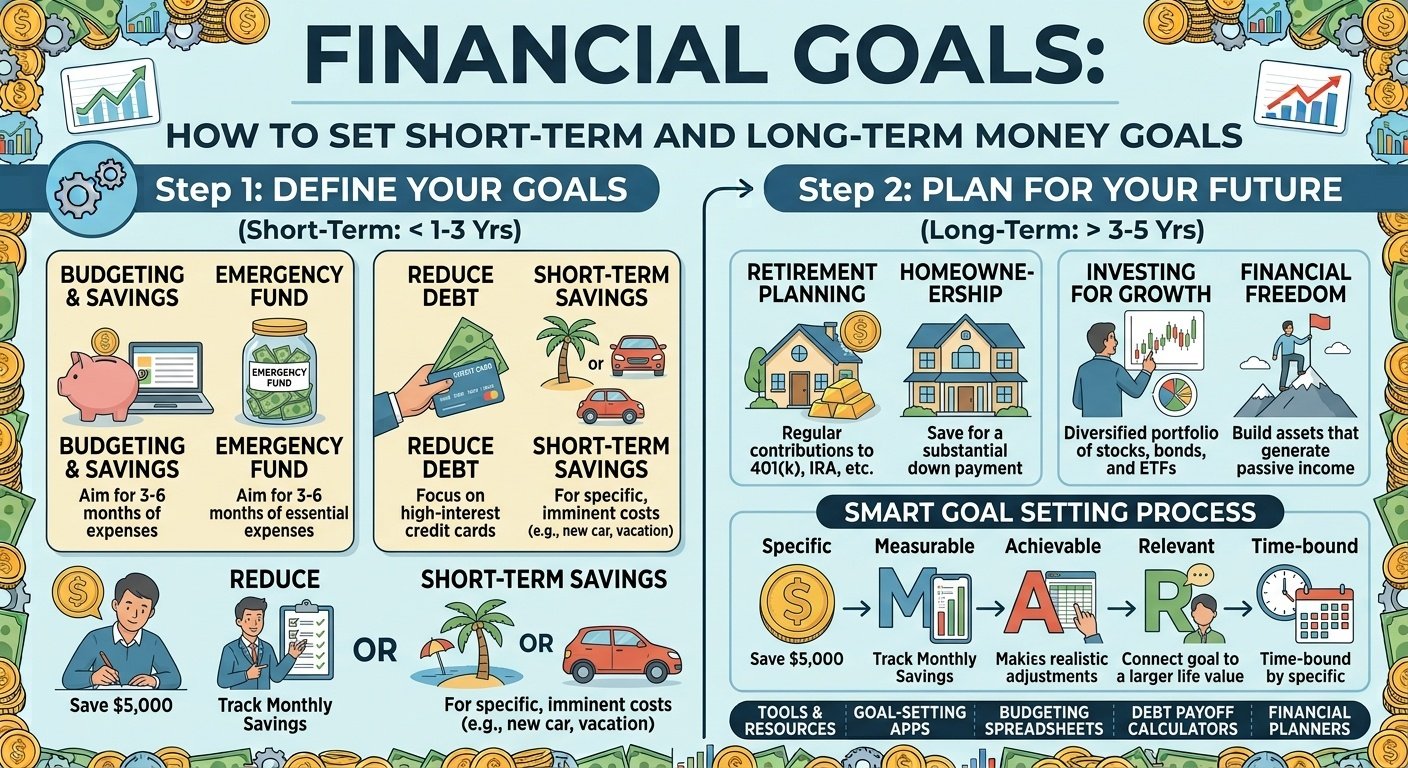
Short-Term Goals (Within About a Year)
These are goals you plan to achieve relatively soon, often within the next several months to a year. Examples include:
- Building a starter emergency fund
- Saving for a holiday or vacation
- Paying off a small credit card balance
- Saving for a specific purchase, like a new appliance or device
Because these goals have a short time horizon, the money is generally best kept in a safe, accessible place, such as a savings account, rather than invested in the stock market, where short-term volatility could work against you.
Medium-Term Goals (Roughly One to Five Years)
These goals typically require more planning and larger amounts of money. Examples include:
- Saving for a home down payment
- Paying off a car loan or larger debt
- Saving for a wedding
- Building a fuller emergency fund
Medium-term goals may involve a mix of saving and, in some cases, conservative investing, depending on the specific timeframe and how much risk feels appropriate.
Long-Term Goals (Five Years or More)
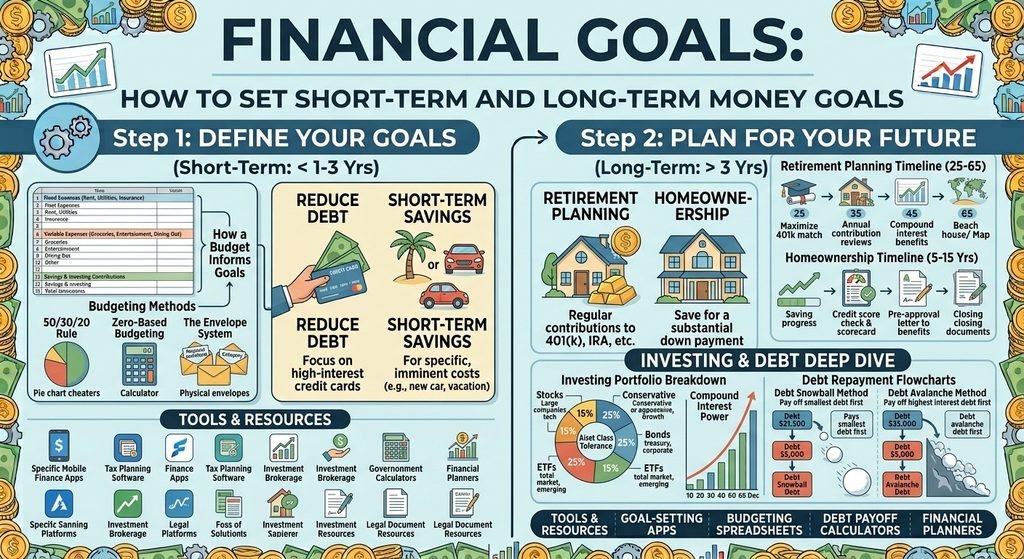
These are goals further in the future, often involving larger amounts of money and benefiting from long-term growth strategies. Examples include:
- Retirement savings
- Paying off a mortgage
- Funding a child’s education
- Building long-term investment wealth
Because of their longer time horizon, long-term goals often make more room for investing, since there’s more time to recover from short-term market fluctuations.
How to Set Effective Financial Goals
Make Goals Specific
A vague goal like “save more money” is harder to act on than a specific one like “save $3,000 for an emergency fund.” Specific goals make it easier to create an actual plan and measure progress.
Make Goals Measurable
Attach a clear number to your goal, whether it’s a savings target, a debt payoff amount, or a monthly contribution goal. This makes it easier to track progress over time.
Make Goals Realistic
While it’s good to be ambitious, goals that are unrealistic given your income and expenses can lead to frustration or abandonment. Consider your actual financial situation when setting targets and timelines.
Set a Timeframe
Attaching a deadline, even an approximate one, helps translate a goal into an actionable plan. For example, “save $6,000 in 12 months” naturally suggests saving $500 per month.
Write Goals Down and Revisit Them
Writing goals down, and reviewing them periodically, helps keep them top of mind rather than becoming vague, forgotten intentions.
A Practical Example: Turning a Goal Into a Plan
Suppose your goal is to save $4,800 for an emergency fund within 12 months. Breaking this down:
- $4,800 ÷ 12 months = $400 per month
- $400 ÷ 4 weeks ≈ $100 per week
This breakdown makes the goal feel more manageable and gives you a clear, concrete target to build into your budget, rather than an abstract, distant number.
Balancing Multiple Financial Goals at Once
Most people are working toward more than one financial goal simultaneously — perhaps building an emergency fund while also paying off debt and contributing to retirement. A few general approaches can help:
Prioritize based on urgency and impact. High-interest debt or a lack of emergency savings often deserves priority, since these areas carry the most immediate financial risk.
Automate smaller, consistent contributions across goals. Even modest, automatic contributions toward multiple goals can add up over time, rather than waiting until one goal is fully funded before starting the next.
Revisit priorities as circumstances change. As one goal is achieved or your financial situation shifts, redirecting funds toward the next priority keeps your overall plan moving forward.
Common Mistakes When Setting Financial Goals
- Setting vague, unmeasurable goals that are difficult to plan around or track
- Setting too many goals at once, which can dilute focus and progress on any single goal
- Ignoring timeframes, making it unclear whether progress is on track
- Not revisiting goals, even after achieving them or after major life changes
- Comparing your goals to others, rather than focusing on what’s realistic and meaningful for your own situation
How to Stay Motivated Toward Financial Goals
- Track progress visually, whether through an app, spreadsheet, or simple chart, since seeing progress can help maintain motivation
- Celebrate milestones, such as reaching 25%, 50%, or 75% of a goal, rather than waiting until full completion
- Automate contributions, reducing the reliance on willpower alone by making saving a consistent, built-in habit
- Revisit your “why”, reconnecting with the underlying reason behind a goal, such as security, freedom, or a specific life event
Key Takeaways
- Financial goals give direction and purpose to saving, budgeting, and spending decisions.
- Goals are often grouped into short-term, medium-term, and long-term categories, each suited to different saving or investing strategies.
- Effective goals tend to be specific, measurable, realistic, and time-bound.
- Balancing multiple goals often involves prioritizing based on urgency, automating contributions, and adjusting as circumstances change.
- Tracking progress and revisiting goals periodically helps maintain motivation and keeps your financial plan relevant.
Conclusion
Setting clear financial goals transforms vague financial intentions into an actionable plan. By defining specific, measurable, and time-bound goals — and organizing them by timeframe — you create a clearer path for your money decisions, whether you’re saving for something next month or planning decades into the future. Progress may not always be linear, but consistent, intentional effort toward well-defined goals tends to produce meaningful financial results