Saving money is often talked about as a matter of willpower — as if the only thing separating a good saver from someone who struggles is discipline. In reality, saving consistently has much more to do with systems and habits than sheer willpower alone. People who save successfully over the long term usually aren’t relying on constant self-control; they’ve built routines that make saving happen automatically, with far fewer decisions required in the moment.
This guide covers practical, realistic strategies for building a genuine savings habit, without requiring an unrealistic overhaul of your entire lifestyle.
Why Saving Money Matters
Savings serve several distinct purposes, and understanding these different roles helps clarify why saving deserves priority in a financial plan:
- Protection against emergencies — Unexpected expenses like medical bills, car repairs, or job loss are far less stressful to handle with savings already set aside, rather than relying on high-interest debt.
- Progress toward specific goals — Whether it’s a home down payment, a wedding, or a vacation, savings turn future goals into concrete, achievable plans.
- Long-term financial security — Retirement savings and other long-term funds build the foundation for financial independence later in life.
- Reduced financial stress — Having a savings cushion, even a modest one, provides a genuine sense of security that affects overall wellbeing, not just your bank balance.
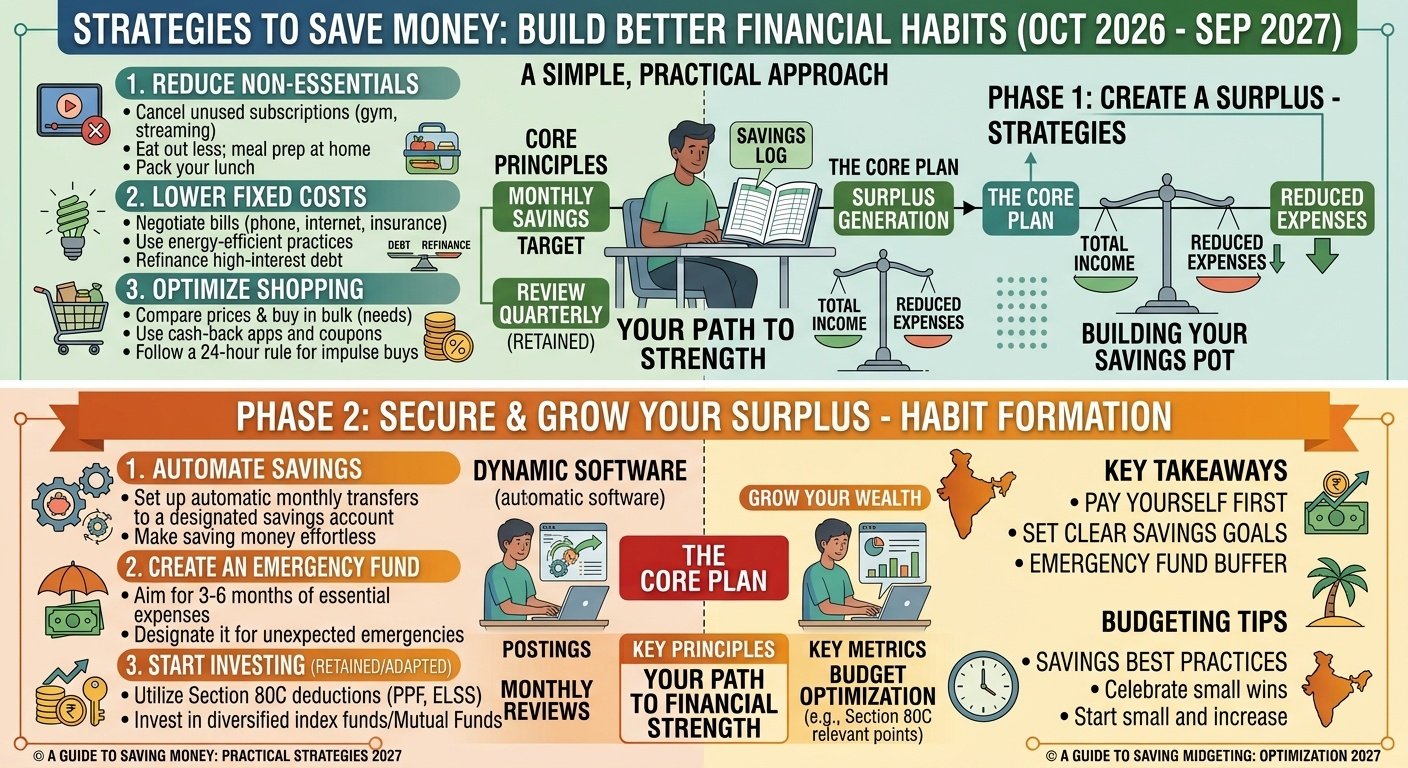
Strategy 1: Automate Your Savings
One of the most effective ways to save consistently is to remove the decision-making from the process entirely. Setting up an automatic transfer from your checking account to a savings account — timed to happen right after payday — means the money is saved before you have a chance to spend it elsewhere.
This approach, often called “paying yourself first,” tends to be far more effective than trying to save whatever happens to be left over at the end of the month, since discretionary spending naturally tends to expand to fill whatever’s available.
Strategy 2: Start With a Realistic, Small Goal
Trying to save a large percentage of your income right away often backfires, leading to frustration and abandonment when it feels unsustainable. Starting with a smaller, genuinely achievable amount — even something modest — builds the habit itself, which matters more early on than the actual dollar amount. Once the habit is established, gradually increasing the amount tends to feel far more manageable than starting aggressively.
Strategy 3: Track Where Your Money Actually Goes
It’s difficult to find room to save without a clear picture of current spending. Reviewing a month or two of bank and card statements often reveals spending patterns — subscriptions rarely used, frequent small purchases that add up, or categories that have quietly grown larger than intended — that provide an obvious starting point for redirecting money toward savings.
Strategy 4: Reduce Recurring Costs First
Recurring expenses — subscriptions, memberships, service plans — tend to be some of the easiest places to find savings, since a single decision (canceling or downgrading a service) creates ongoing savings without requiring repeated willpower each month. Reviewing recurring charges periodically, rather than just at sign-up, often reveals services that are no longer being used or valued as much as when they were first subscribed to.
Strategy 5: Use the “Savings Rate Increase” Approach
Rather than saving a fixed amount indefinitely, consider gradually increasing your savings rate over time — particularly whenever your income increases. Directing a portion of any raise or bonus toward savings, before it becomes part of your regular spending baseline, allows your savings to grow alongside your income without requiring a noticeable reduction in your current lifestyle.
Strategy 6: Separate Savings by Goal
Keeping all savings in a single account can make it harder to track progress toward specific goals and easier to accidentally dip into money meant for one purpose to cover something else. Separating savings into distinct accounts or clearly labeled categories — an emergency fund, a vacation fund, a home down payment fund — creates clearer boundaries and often increases motivation, since progress toward each specific goal becomes easier to see.
Strategy 7: Reduce Costs Without Sacrificing What Matters Most
Cutting costs doesn’t have to mean eliminating everything enjoyable from your budget. A more sustainable approach involves identifying which expenses genuinely add value to your life and which ones don’t, then focusing cuts on the latter. This might mean reducing spending in categories that don’t matter much to you personally, while maintaining spending in areas that genuinely improve your quality of life — an approach far more sustainable than blanket austerity across every category.
Strategy 8: Use Windfalls Wisely
Tax refunds, bonuses, cash gifts, and other unexpected windfalls present a natural opportunity to boost savings significantly, without affecting your regular monthly budget at all. While it’s reasonable to allocate some portion of a windfall toward enjoyment, directing a meaningful share toward savings or debt repayment can meaningfully accelerate progress toward financial goals.
Common Obstacles to Saving Money — and How to Handle Them
“I Don’t Have Enough Income to Save”
Even small, consistent amounts add up meaningfully over time, and building the habit itself matters more early on than the dollar amount. As income grows, the habit is already established, making it easier to increase savings rates naturally.
“I Keep Dipping Into My Savings”
This often points to either an unrealistic budget elsewhere, or savings that aren’t clearly separated from everyday spending accounts. Creating physical or digital separation — a distinct savings account not linked to an easily accessible debit card — can reduce the temptation to treat savings as available spending money.
“Saving Feels Boring or Unmotivating”
Tying savings to specific, meaningful goals — rather than saving in the abstract — tends to increase motivation. Visualizing what the money is actually for, and tracking visible progress toward that specific goal, often makes the process feel less like pure sacrifice.
Building Savings Into a Long-Term Habit
Sustainable saving isn’t typically the result of one dramatic decision — it’s built through small, consistent actions repeated over time. A few principles that support this long-term consistency:
- Automate wherever possible, reducing the number of ongoing decisions required.
- Review your budget and savings periodically, adjusting as your income and circumstances change.
- Celebrate progress along the way, rather than only focusing on the final goal amount.
- Be forgiving of occasional setbacks, treating them as normal rather than reasons to abandon the habit entirely.
Key Takeaways
- Saving consistently depends more on systems and habits than pure willpower.
- Automating savings transfers removes the need for ongoing decision-making and tends to be more effective than saving “whatever’s left.”
- Starting with a small, realistic savings goal builds the habit before scaling up the amount.
- Reviewing recurring expenses often reveals easy, ongoing opportunities to redirect money toward savings.
- Separating savings by specific goal tends to increase motivation and reduce the temptation to dip into savings.
- Windfalls like bonuses or refunds offer a natural opportunity to boost savings without affecting your regular budget.
Conclusion
Saving money effectively isn’t about extreme discipline or dramatic lifestyle changes — it’s about building small, consistent systems that reduce the number of decisions you need to make in the moment. Automating transfers, tracking spending, separating goals, and gradually increasing your savings rate over time all work together to turn saving from an occasional effort into a lasting financial habit.