For anyone who’s tried budgeting and felt overwhelmed by tracking dozens of individual spending categories, the 50/30/20 rule offers a refreshingly simple alternative. Rather than micromanaging every purchase, it divides your entire income into just three broad buckets, giving you a clear structure without demanding constant detailed tracking. It’s become one of the most widely recommended starting points for beginners precisely because of how straightforward it is to understand and apply.
This guide explains exactly how the 50/30/20 rule works, how to apply it to your own income, and when it might need adjusting to fit your specific situation.
What Is the 50/30/20 Rule?
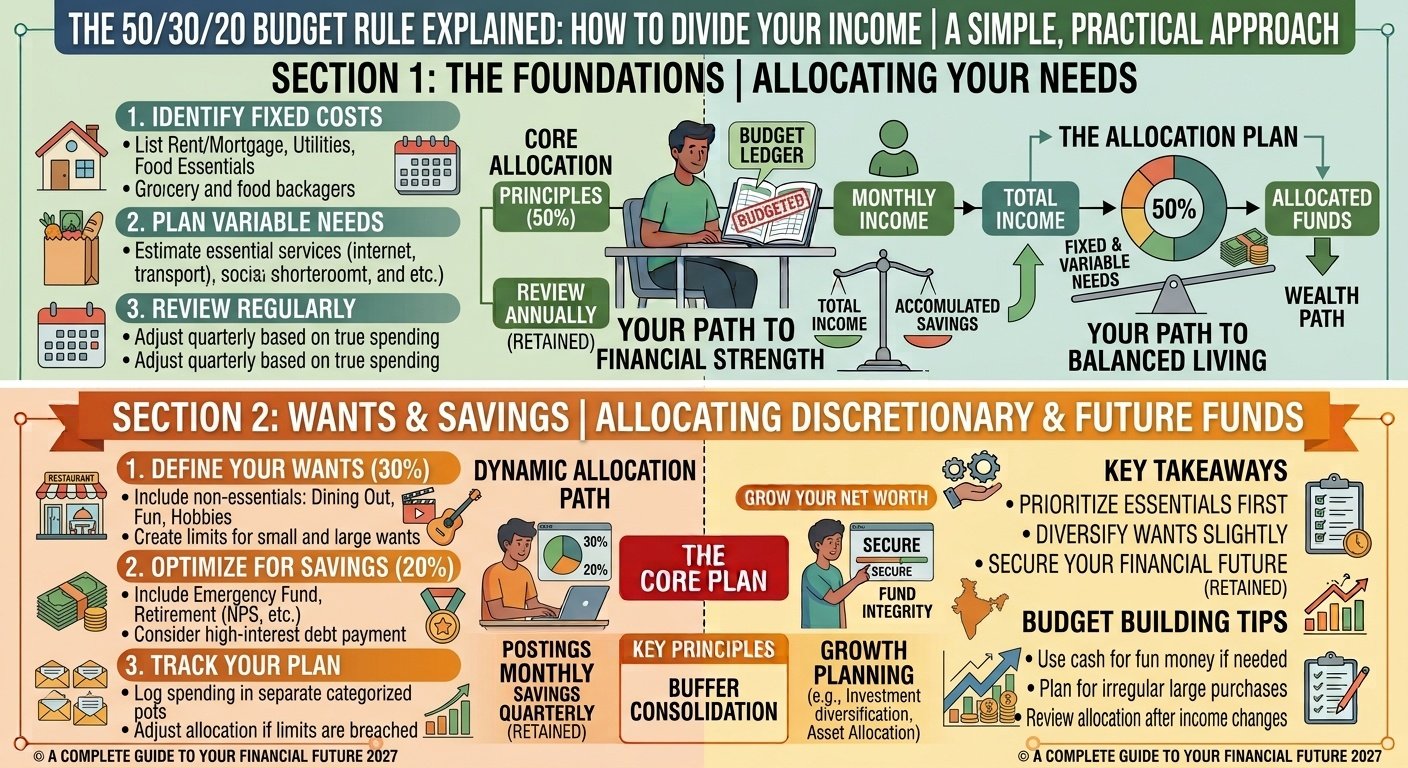
The 50/30/20 rule is a budgeting framework that divides your after-tax (take-home) income into three categories:
- 50% for Needs — Essential expenses required for basic living
- 30% for Wants — Discretionary, non-essential spending
- 20% for Savings and Debt Repayment — Money set aside for financial goals and paying down debt beyond minimum payments
The rule was popularized as a simple way to bring structure to budgeting without requiring detailed tracking of dozens of separate categories, making it particularly approachable for people who find more complex budgeting systems difficult to maintain.
Breaking Down Each Category
Needs (50%)
This category covers expenses that are genuinely necessary for daily living — the costs you’d need to cover regardless of your personal preferences or lifestyle choices. Common examples include:
- Rent or mortgage payments
- Utilities (electricity, water, gas)
- Groceries (basic food needs, not dining out)
- Insurance premiums (health, auto, home/renters)
- Minimum debt payments
- Transportation costs necessary for work or essential activities
- Childcare, if applicable
The key distinguishing factor for this category is necessity — these are costs you can’t reasonably eliminate without significantly impacting your basic ability to live and function.
Wants (30%)
This category covers discretionary spending — things that improve your quality of life or provide enjoyment, but aren’t strictly necessary for basic living. Common examples include:
- Dining out and takeout food
- Entertainment (streaming subscriptions, movies, concerts)
- Hobbies and recreational activities
- Non-essential shopping (clothing beyond basic needs, gadgets)
- Vacations and travel
- Upgraded versions of necessities (a nicer apartment than strictly needed, a more expensive car than required for transportation)
This is typically the category with the most flexibility, since these expenses can usually be adjusted up or down without threatening your basic ability to meet essential needs.
Savings and Debt Repayment (20%)
This category covers money directed toward your financial future — beyond simply meeting minimum obligations. It includes:
- Emergency fund contributions
- Retirement savings
- Additional debt payments beyond the required minimum (specifically targeting faster payoff)
- General savings goals (a home down payment, a major purchase)
- Investment contributions
This category is what actually moves your financial position forward over time, making it an important category to protect, even when other areas of the budget feel tight.
How to Apply the 50/30/20 Rule to Your Own Income
Step 1: Calculate Your After-Tax Income
Start with your take-home pay — your income after taxes and other mandatory deductions, not your gross salary. This is the actual amount available to allocate across the three categories.
Step 2: Calculate Each Category’s Target Amount
Multiply your after-tax monthly income by each percentage to find your target spending amount per category. For example, with a monthly take-home income of $4,000:
- Needs (50%): $2,000
- Wants (30%): $1,200
- Savings/Debt Repayment (20%): $800
Step 3: Categorize Your Current Expenses
Review your actual spending and sort it into the three categories, giving you a clear comparison between your current allocation and the 50/30/20 targets.
Step 4: Adjust Where Needed
If your current spending in any category significantly exceeds the target, look for realistic adjustments — particularly within the Wants category, since it typically offers the most flexibility without affecting essential living costs.
When the 50/30/20 Rule Needs Adjusting
While the 50/30/20 rule works well as a general starting framework, it doesn’t perfectly fit every financial situation. A few common scenarios where adjustment makes sense:
High Cost-of-Living Areas
In areas with particularly expensive housing markets, needs alone might reasonably exceed 50% of income, especially for essential costs like rent. In these cases, adjusting the ratio — perhaps to something like 60/20/20 — may better reflect genuine financial reality without requiring unrealistic cuts elsewhere.
High-Interest Debt Situations
If you’re carrying significant high-interest debt, it may make sense to temporarily allocate more than 20% toward debt repayment, accelerating payoff and reducing the amount of interest paid over time, even if it means temporarily reducing the Wants category further.
Variable or Irregular Income
For people with inconsistent income, like freelancers or commission-based earners, applying fixed percentages to a fluctuating income base can be more challenging. In these cases, budgeting based on a conservative average or your lowest typical month, combined with more flexible category allocations, often works better than rigid percentage targets.
Lower Income Levels
At lower income levels, the 50% needs category may not be sufficient to cover genuinely essential expenses, since certain costs (housing, utilities) don’t scale down proportionally with lower income. In these situations, needs may reasonably take up a larger share, with wants correspondingly reduced.
Advantages of the 50/30/20 Rule
- Simplicity. Three broad categories are far easier to track and maintain than dozens of detailed subcategories.
- Flexibility within categories. As long as you stay within each percentage target, you have freedom in how you allocate spending within that category.
- A built-in savings component. Unlike some budgeting approaches that only focus on spending, the 20% savings allocation ensures financial progress is built directly into the framework.
- A strong starting point for beginners. For anyone new to budgeting, the 50/30/20 rule offers immediate structure without an overwhelming learning curve.
Limitations to Keep in Mind
- Doesn’t account for individual circumstances by default — the fixed percentages may not fit everyone’s cost of living, income level, or financial priorities without some adjustment.
- Less precise than detailed budgeting methods like zero-based budgeting, which assigns every dollar a specific purpose rather than working within broad percentage ranges.
- Categorization can sometimes be ambiguous — certain expenses (a moderately priced gym membership, for example) can reasonably fall into either the Needs or Wants category depending on personal circumstances and priorities.
Is the 50/30/20 Rule Right for You?
The 50/30/20 rule tends to work particularly well for people who want a simple, low-maintenance budgeting structure without extensive tracking, and whose income and cost of living reasonably align with the standard percentages. It’s often an excellent starting point even for those who eventually move toward a more detailed budgeting method, since it establishes the basic habit of intentionally dividing income across essential spending, discretionary spending, and financial progress.
If your specific situation doesn’t fit the standard percentages well — due to cost of living, debt priorities, or income variability — treating the 50/30/20 rule as a flexible starting framework, rather than a strict requirement, allows you to adapt it while still benefiting from its underlying structure.
Key Takeaways
- The 50/30/20 rule divides after-tax income into 50% needs, 30% wants, and 20% savings/debt repayment.
- Needs cover essential living costs; wants cover discretionary spending; savings/debt repayment covers financial progress beyond minimum obligations.
- The rule is a flexible starting framework, not a rigid requirement — adjustments are reasonable based on cost of living, debt priorities, or income variability.
- It’s particularly well-suited to beginners looking for a simple, low-maintenance budgeting structure.
Conclusion
The 50/30/20 rule succeeds because it makes budgeting approachable without sacrificing the core benefit of intentional money management — dividing income across essential needs, personal enjoyment, and financial progress. While it may need adjustment to fit your specific circumstances, it remains one of the most practical starting points for anyone looking to bring structure to their finances without an overwhelming, detail-heavy system.