If there’s one financial concept worth truly understanding, it’s compound interest. Often described as one of the most powerful forces in personal finance, compound interest is the reason a small amount of money saved consistently over time can grow into a significant sum — without you having to do anything beyond letting it sit and grow.
This guide explains what compound interest is, how it works, and why understanding it can change the way you think about saving and investing.
What Is Compound Interest?
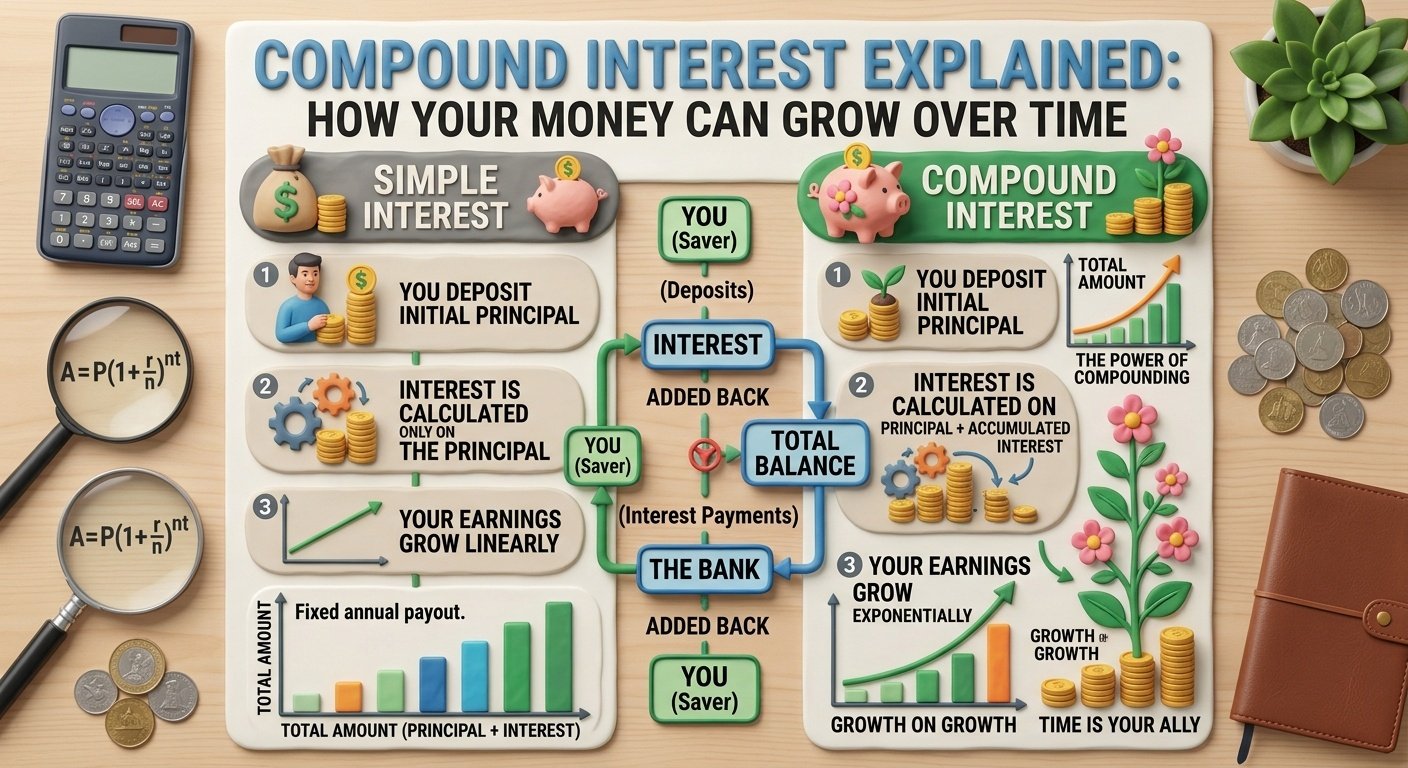
Compound interest is interest calculated not only on the original amount of money you deposit or invest (called the principal), but also on the interest that has already been added to it. In other words, your interest starts earning its own interest.
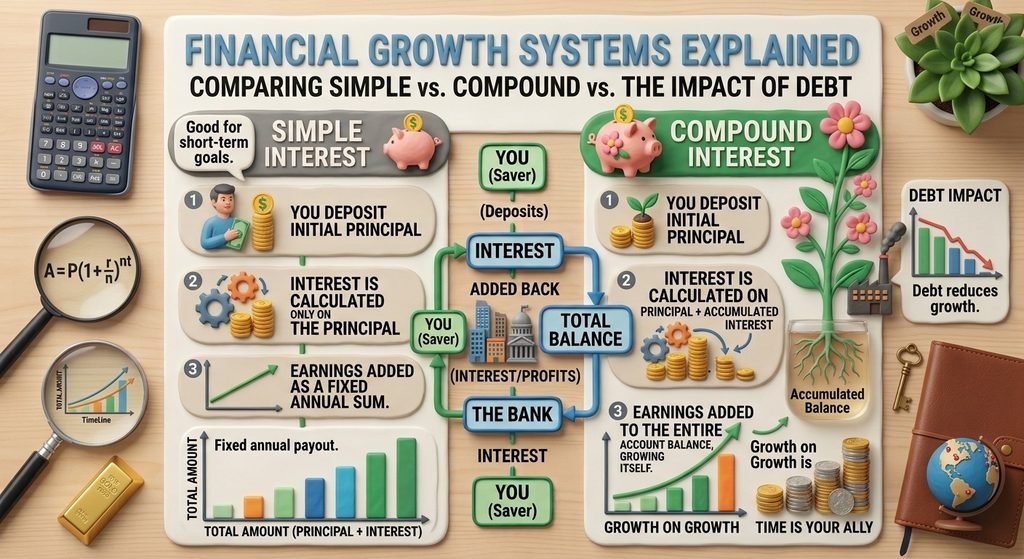
This is different from simple interest, which is calculated only on the original principal, regardless of how much interest has accumulated over time.
Simple Interest vs Compound Interest
Understanding the difference between these two types of interest makes it much easier to see why compounding matters.
| Feature | Simple Interest | Compound Interest |
|---|---|---|
| Calculated on | Principal only | Principal plus accumulated interest |
| Growth pattern | Linear (steady) | Exponential (accelerating) |
| Common uses | Some personal loans | Savings accounts, investments, credit cards |
| Long-term impact | Slower growth | Faster growth over time |
A Simple Comparison
Imagine you deposit $1,000 at a 5% annual interest rate for 10 years.
- With simple interest, you’d earn $50 every year, ending with $1,500 after 10 years.
- With compound interest (compounded annually), your balance would grow to approximately $1,628.89 after 10 years, since each year’s interest is calculated on a growing balance.
The longer the time period, the larger this gap becomes.
How Compound Interest Works, Step by Step
Compound interest works through a repeating cycle:
- Interest is calculated based on your current balance.
- That interest is added to your balance.
- The next round of interest is calculated on the new, larger balance.
- This cycle repeats over each compounding period.
The Compound Interest Formula
While you don’t need to memorize this to benefit from compounding, understanding the formula can help clarify how it works:
A = P (1 + r/n)^(nt)
Where:
- A = the final amount
- P = the principal (initial amount)
- r = annual interest rate (as a decimal)
- n = number of times interest is compounded per year
- t = number of years
This formula shows that both the interest rate and the compounding frequency directly affect how quickly your money grows.
Why Compounding Frequency Matters
Interest can be compounded at different intervals — daily, monthly, quarterly, or annually. Generally, the more frequently interest compounds, the faster your balance grows, since interest is being calculated and added more often.
For example, a savings account that compounds interest daily will typically result in slightly higher returns than one that compounds annually, even with the same stated interest rate.
Why Starting Early Makes Such a Big Difference
One of the most important lessons about compound interest is the impact of time. Because compounding builds on itself, money invested earlier has more time to grow, even if the amount invested is relatively small.
Example: The Power of Starting Early
Consider two people:
- Person A invests $200 per month starting at age 25, stopping at age 35 (10 years of contributions), then leaves the money to grow untouched.
- Person B invests $200 per month starting at age 35 and continues until age 65 (30 years of contributions).
Even though Person B contributed for three times as long, Person A — who started 10 years earlier and stopped contributing much sooner — often ends up with a comparable or even larger balance by retirement age, purely because their money had more years to compound.
This example illustrates why financial experts consistently emphasize starting to save and invest as early as possible.
Where Compound Interest Applies
Compound interest isn’t limited to savings accounts. It plays a role in several areas of personal finance:
- Savings accounts: Interest earned grows your balance over time.
- Certificates of deposit (CDs): Often compound interest over a fixed term.
- Investment accounts: Returns can compound as reinvested dividends or gains generate further growth.
- Retirement accounts: Long-term compounding is a major factor in retirement savings growth.
- Credit cards and loans: Compound interest can also work against you if you carry a balance, since unpaid interest gets added to what you owe.
How to Use Compound Interest to Your Advantage
- Start saving or investing as early as possible. Time is one of the most important factors in compounding.
- Reinvest your earnings. Allowing interest, dividends, or returns to remain invested lets compounding continue uninterrupted.
- Contribute consistently. Regular contributions, even small ones, add to the base amount that compounds over time.
- Choose accounts with favorable compounding frequency. More frequent compounding can slightly improve your returns.
- Avoid withdrawing early. Interrupting the compounding process reduces its long-term benefit.
How Compound Interest Can Work Against You
While compounding is a powerful tool for growth, it can also work in the opposite direction when it comes to debt. Credit cards and some loans use compound interest, meaning unpaid interest gets added to your balance, which then accrues additional interest. This can cause debt to grow quickly if only minimum payments are made.
Understanding this dynamic is a strong reason to prioritize paying off high-interest debt as quickly as possible.
Key Takeaways
- Compound interest is calculated on both the principal and previously earned interest, leading to accelerating growth over time.
- The earlier you start saving or investing, the more time compounding has to work in your favor.
- Compounding frequency and consistent contributions both influence how quickly your money grows.
- Compound interest can also increase debt quickly if balances aren’t paid off, particularly with credit cards.
Conclusion
Compound interest is often called one of the most powerful tools in personal finance, and for good reason. By allowing interest to build on itself, your money can grow significantly faster over time compared to simple interest. Whether you’re saving for an emergency fund, investing for retirement, or trying to understand how debt accumulates, understanding compound interest helps you make smarter decisions and take full advantage of time as one of your greatest financial assets.