Interest is one of the most fundamental concepts in personal finance, yet many people only have a vague understanding of how it actually works. Whether you’re earning interest on a savings account or paying interest on a loan or credit card, this single number can significantly affect your financial life over time.
This guide breaks down how bank interest works in plain language, covering both sides of the equation: how banks pay you interest, and how you pay interest to them.
What Is Interest?
Interest is essentially the cost of using money. When you deposit money in a bank, the bank pays you interest for the use of your funds. When you borrow money, you pay interest to the lender for the privilege of using their funds before you’ve earned it yourself.
In both cases, interest is usually expressed as a percentage of the amount involved, calculated over a specific period of time — most commonly a year, referred to as an annual interest rate.
How Banks Use Your Money to Pay Interest
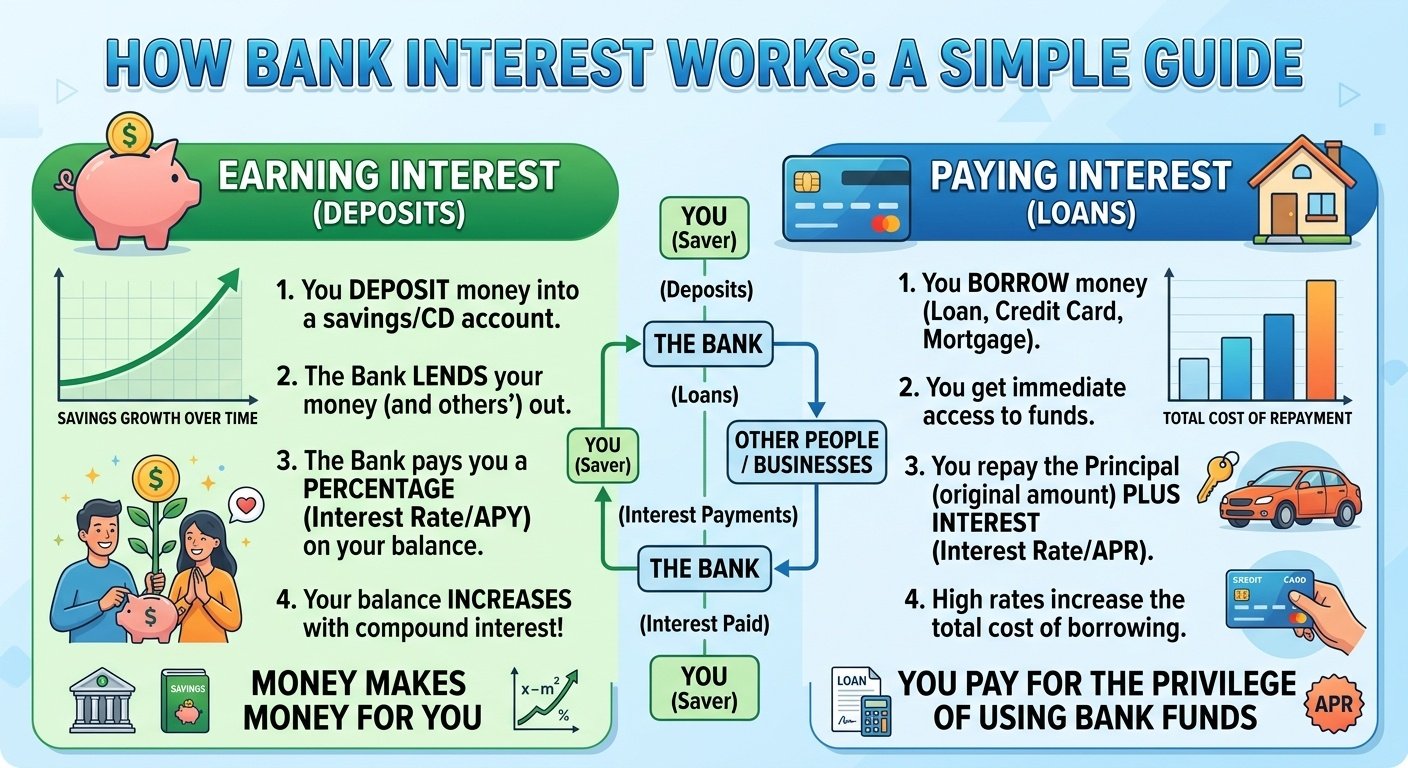
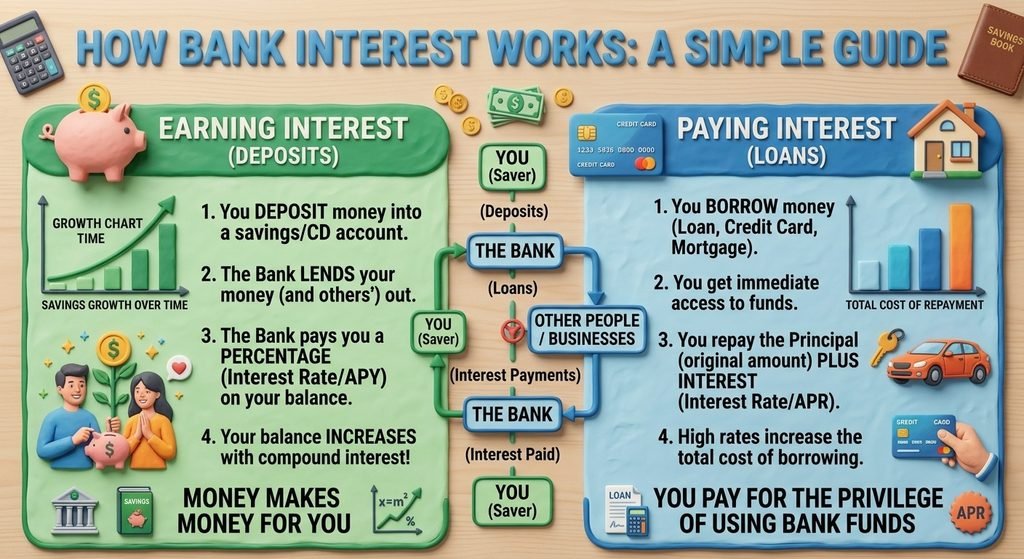
When you deposit money into a savings account, the bank doesn’t just let it sit untouched. Banks use deposited funds to issue loans to other customers, charging those borrowers interest. A portion of that interest is then passed back to depositors in the form of the interest paid on savings accounts.
This is why interest rates on loans are typically higher than interest rates on savings accounts — the difference is part of how banks generate revenue.
Earning Interest: How It Works on Savings
When you earn interest, your money grows over time without any additional effort on your part. The amount you earn depends on a few key factors:
- Interest rate: The percentage the bank pays, often expressed as an Annual Percentage Yield (APY).
- Account balance: Higher balances generally earn more interest in absolute terms.
- Compounding frequency: How often interest is calculated and added to your balance — daily, monthly, or annually.
- Time: The longer your money stays in the account, the more interest accumulates.
Simple Interest vs Compound Interest
There are two main ways interest can be calculated:
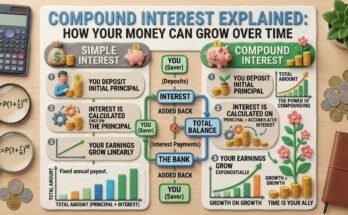
Simple interest is calculated only on the original amount deposited (the principal), without factoring in previously earned interest.
Compound interest is calculated on both the principal and any interest that has already been added to the account. Over time, this creates a snowball effect where your money grows faster than it would with simple interest.
Most savings accounts use compound interest, which is one of the reasons starting to save early can make a meaningful difference over the long run.
A Simple Example
Suppose you deposit $1,000 into a savings account with a 3% annual interest rate, compounded yearly.
- After year 1: $1,000 + 3% = $1,030
- After year 2: $1,030 + 3% = $1,060.90
- After year 3: $1,060.90 + 3% = $1,092.73
Notice that the amount of interest earned grows slightly each year, since it’s calculated on an increasingly larger balance.
Paying Interest: How It Works on Loans and Credit
When you borrow money — through a loan, credit card, or line of credit — you agree to pay back the amount borrowed plus interest. This is how lenders earn a profit for taking on the risk of lending to you.
Key factors that affect how much interest you pay include:
- Interest rate: Often expressed as an Annual Percentage Rate (APR), which may include certain fees in addition to the base interest rate.
- Loan term: Longer repayment periods generally result in more total interest paid, even if the interest rate stays the same.
- Payment amount and frequency: Making larger or more frequent payments can reduce the total interest you pay over time.
- Type of interest: Some loans use simple interest, while others, particularly credit cards, use compound interest.
Why Credit Card Interest Can Add Up Quickly
Credit cards typically use compound interest, and interest rates on credit cards tend to be significantly higher than those on savings accounts or many types of loans. If you only make minimum payments, a large portion of your payment may go toward interest rather than reducing the actual balance you owe, which can cause debt to grow substantially over time.
Fixed vs Variable Interest Rates
Interest rates can also be categorized by whether they change over time.
- Fixed interest rate: Stays the same for the life of the account or loan, providing predictability.
- Variable interest rate: Can change based on broader market conditions, meaning your payments or earnings may fluctuate.
Understanding which type applies to your account or loan helps you plan your finances more accurately.
How to Make Interest Work in Your Favor
- Choose savings accounts with competitive interest rates. Rates can vary significantly between banks, so comparing options is worthwhile.
- Take advantage of compounding. The earlier you start saving, the more time compound interest has to work in your favor.
- Pay down high-interest debt quickly. Reducing balances on credit cards or high-interest loans limits how much interest accumulates against you.
- Understand the terms before borrowing. Always review whether a loan uses fixed or variable rates, and how interest is calculated.
- Avoid only making minimum payments. This often maximizes the interest you pay over the life of a loan or credit card balance.
Common Mistakes People Make with Interest
- Ignoring the difference between APR and APY, which can lead to confusion about actual costs or earnings.
- Assuming all savings accounts offer similar interest rates, without comparing options.
- Carrying credit card balances without understanding how quickly compound interest can increase the total owed.
- Not accounting for compounding frequency, which can affect the real return on savings.
Key Takeaways
- Interest is the cost of using money — banks pay you interest on deposits and charge interest on loans.
- Compound interest grows your savings faster over time compared to simple interest.
- Credit cards typically use compound interest, which can cause debt to grow quickly if not managed carefully.
- Comparing interest rates and understanding loan terms can help you save more and pay less in interest.
Conclusion
Understanding how bank interest works — both when you earn it and when you pay it — is a foundational piece of financial literacy. Interest can either grow your savings steadily over time or quietly increase the cost of your debt if left unmanaged. By understanding the difference between simple and compound interest, comparing rates, and making informed borrowing and saving decisions, you can put interest to work in your favor rather than against you.