Carrying debt can feel overwhelming, especially when it seems like your payments barely make a dent in what you owe. But paying off debt is rarely about finding one magic solution — it’s about choosing a clear strategy, sticking with it consistently, and making steady progress over time.
Whether you’re dealing with credit card balances, personal loans, student loans, or a mix of several debts, having a structured plan can make the process feel far more manageable. This article walks through practical, realistic strategies for paying off debt, along with common mistakes to avoid along the way.
Step 1: Get a Clear Picture of What You Owe
Before creating a payoff plan, it helps to list out every debt you have, including:
- The total balance owed
- The interest rate
- The minimum monthly payment
- The due date
Having this information in one place — whether in a spreadsheet, app, or notebook — makes it much easier to prioritize and track your progress. Many people underestimate their total debt simply because it’s spread across multiple accounts they don’t look at together.
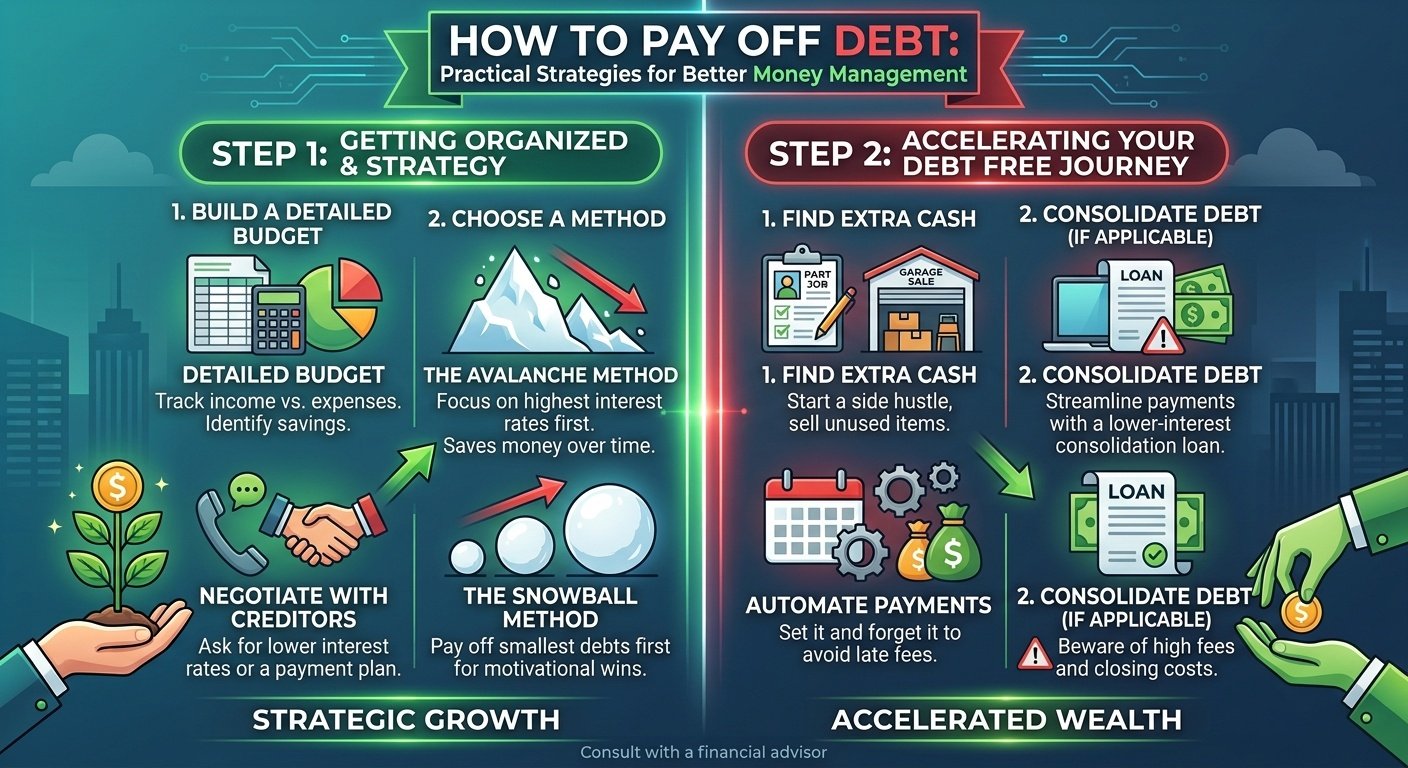
Step 2: Review Your Budget
Paying off debt faster usually requires finding extra money to put toward payments beyond the minimum. Reviewing your budget can help identify:
- Non-essential expenses that can be temporarily reduced
- Subscriptions or services you no longer need
- Areas where spending has crept up over time
Even modest adjustments, redirected consistently toward debt, can add up meaningfully over months and years.
Step 3: Choose a Debt Payoff Strategy
There are two widely used strategies for paying off multiple debts. Both work — the right choice often depends on your personality and what will keep you motivated.
The Debt Avalanche Method
With this approach, you list your debts from highest interest rate to lowest. You pay the minimum on all debts, but put any extra money toward the debt with the highest interest rate first. Once that’s paid off, you move to the next-highest rate, and so on.
Advantage: This method typically saves the most money in interest over time, since you’re tackling the most expensive debt first.
Challenge: Progress on the highest-interest debt can feel slow at first, especially if it also has a large balance, which can be discouraging for some people.
The Debt Snowball Method
With this approach, you list your debts from smallest balance to largest, regardless of interest rate. You pay the minimum on all debts, but put extra money toward the smallest balance first. Once it’s paid off, you roll that payment into the next-smallest balance.
Advantage: Paying off smaller debts quickly can create a sense of momentum and motivation, which helps some people stay consistent.
Challenge: This method may cost more in total interest compared to the avalanche method, since higher-interest debts might take longer to pay off.
Which Method Should You Choose?
There’s no universally “correct” answer. If saving the most money is your top priority and you’re comfortable staying disciplined without early wins, the avalanche method may suit you better. If you tend to lose motivation without visible progress, the snowball method’s quick wins might help you stay on track. The best method is the one you’ll actually stick with.
Step 4: Consider Consolidation or Refinancing (With Caution)
In some cases, consolidating multiple debts into a single loan with a lower interest rate can simplify payments and reduce interest costs. Options may include:
- Balance transfer credit cards, which sometimes offer a temporary low or 0% introductory rate
- Personal loans, used to pay off higher-interest debts with a single fixed-rate loan
- Debt consolidation programs, offered by some credit counseling organizations
These options can be useful tools, but they aren’t automatically beneficial. Watch for:
- Balance transfer fees or promotional rates that expire
- Origination fees on personal loans
- The risk of running up new balances on cards you’ve just paid off
Consolidation works best when it’s paired with a real change in spending habits — otherwise, it can lead to more debt rather than less.
Step 5: Avoid Taking on New Debt While Paying Off Old Debt
This may sound obvious, but it’s one of the most common obstacles to becoming debt-free. Building a small buffer of savings, even a modest emergency fund, can help prevent unexpected expenses from turning into new credit card balances while you’re trying to pay down existing debt.
Common Mistakes When Paying Off Debt
- Only paying the minimum. Minimum payments are structured to keep you in debt longer, since a large portion often goes toward interest rather than the principal balance.
- Ignoring interest rates. Focusing only on balance size without considering interest rates can result in paying more than necessary over time.
- Ignoring emergency savings entirely. Without any cushion, one unexpected expense can undo months of progress.
- Closing paid-off credit cards immediately. This can sometimes affect your credit utilization and credit history length, which may impact your credit score. It’s often better to keep the account open with a zero balance, unless there’s a specific reason to close it.
- Losing motivation without tracking progress. Not reviewing progress regularly can make debt payoff feel endless, even when real progress is happening.
Table: Avalanche vs Snowball Method
| Feature | Avalanche Method | Snowball Method |
|---|---|---|
| Order of payoff | Highest interest rate first | Smallest balance first |
| Total interest paid | Typically lower | Typically higher |
| Motivation factor | Slower early progress | Faster early wins |
| Best suited for | Disciplined, numbers-focused approach | Motivation-driven approach |
Key Takeaways
- Start by listing all your debts, including balances, interest rates, and minimum payments.
- Reviewing your budget can free up extra money to put toward debt faster.
- The avalanche method saves more on interest; the snowball method offers faster motivational wins.
- Consolidation can help in some cases, but only when paired with responsible spending habits.
- Avoid taking on new debt while paying down existing balances, and keep some emergency savings as a buffer.

Conclusion
Paying off debt is rarely quick, but it is achievable with a clear plan and consistent effort. Understanding exactly what you owe, choosing a payoff strategy that fits your personality, and avoiding new debt along the way can turn an overwhelming balance into a manageable, steadily shrinking number. Progress may feel slow some months, but each payment moves you closer to financial flexibility and peace of mind.