Debt often gets treated as a single, uniformly negative thing. Many people grow up hearing that borrowing money is risky or irresponsible, and in some cases that’s true. But debt itself is not automatically good or bad — what matters is why you’re borrowing, what the money is used for, and how the debt affects your long-term financial position.
Some debt can help you build wealth, increase your earning potential, or acquire an asset that grows in value. Other debt simply drains your income through high interest payments while leaving you with nothing of lasting value. Learning to tell these two categories apart is one of the most useful skills in personal finance, because it changes how you think about borrowing decisions for years to come.
This article breaks down what separates good debt from bad debt, gives real examples of each, and explains how to think more carefully before taking on new debt.
What Makes Debt “Good”?
Good debt generally shares a few common traits. It tends to:
- Finance something that increases in value or increases your income over time
- Carry a relatively low interest rate
- Come with manageable, predictable repayment terms
- Support a long-term financial goal rather than a short-term want
The idea isn’t that good debt is free of risk — all debt carries some risk. Rather, good debt is borrowing that has a reasonable chance of leaving you financially better off than if you hadn’t borrowed at all.
Common Examples of Good Debt
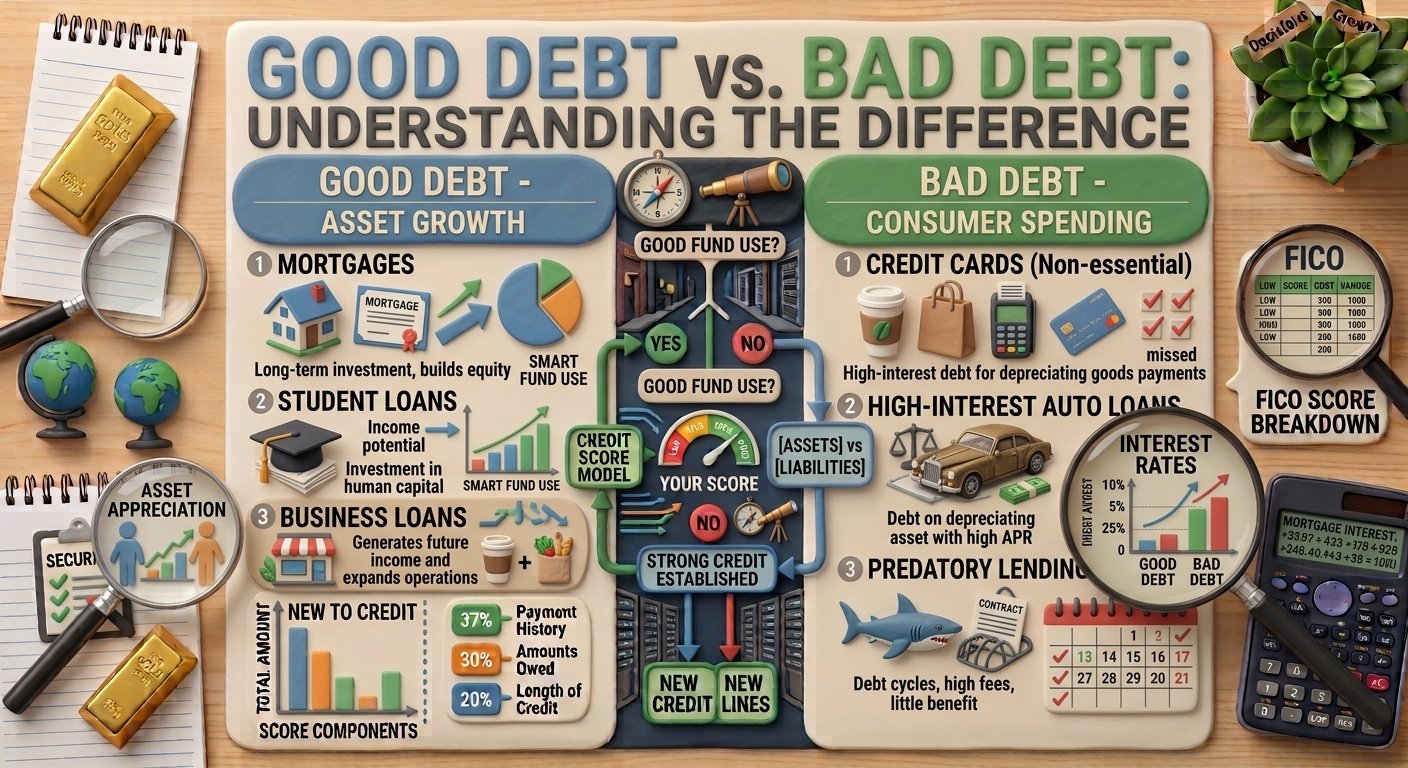
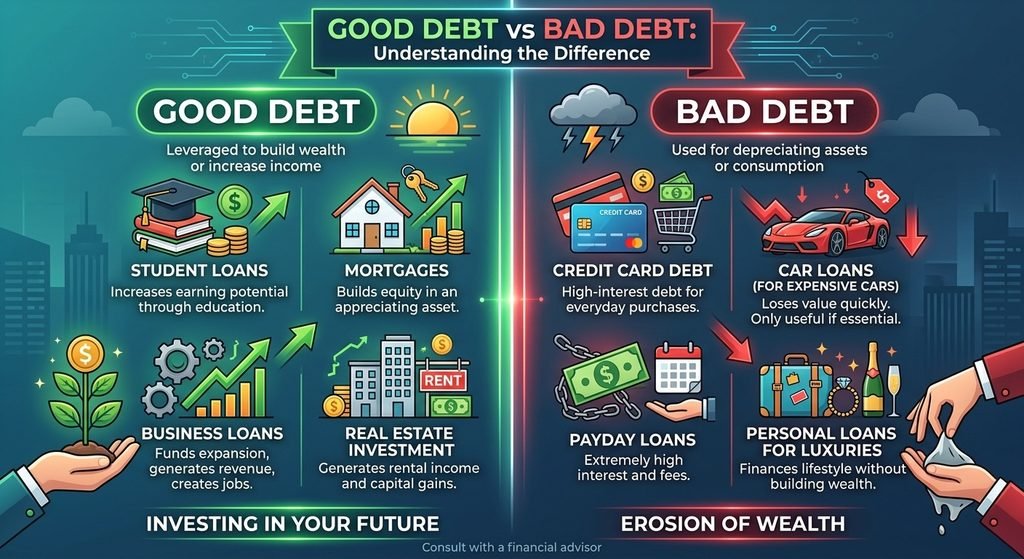
Student loans (used wisely). Education debt used to gain skills or credentials that lead to higher earning potential can be considered good debt, particularly when the expected increase in income outweighs the cost of borrowing. This isn’t guaranteed for every degree or program, so it’s worth researching expected career outcomes before borrowing heavily.
Mortgages. A home loan lets you build equity in a property over time, rather than paying rent with nothing to show for it afterward. Real estate can also appreciate in value, although this isn’t guaranteed and depends on the market and location.
Business loans. Borrowing to start or grow a business can be good debt if the funds are used to generate revenue that exceeds the cost of the loan. This depends heavily on the strength of the business plan and the borrower’s ability to manage risk.
Some types of investment-related borrowing. In limited cases, such as certain real estate investments, debt can be used strategically to acquire income-generating assets. This is a more advanced strategy and carries higher risk, so it’s not appropriate for every borrower.
What Makes Debt “Bad”?
Bad debt typically shares the opposite traits. It tends to:
- Finance something that loses value quickly or provides no lasting benefit
- Carry a high interest rate
- Be used for short-term wants rather than long-term needs
- Grow faster than the borrower’s ability to repay it
Common Examples of Bad Debt
Credit card debt for everyday spending. Credit cards often carry high interest rates, and carrying a balance for non-essential purchases — dining out, entertainment, clothing — means paying significantly more than the original cost of the item over time.
Payday loans. These short-term loans typically come with extremely high fees and interest rates, making them one of the most expensive ways to borrow money. They’re generally considered harmful except as an absolute last resort.
Auto loans for vehicles beyond your budget. Cars lose value the moment they’re driven off the lot, and financing a vehicle that stretches your budget can leave you paying interest on a depreciating asset for years.
Financing lifestyle purchases. Using loans or credit to fund vacations, luxury items, or other discretionary spending is generally considered bad debt, since it doesn’t build any lasting financial value.
It’s Not Always Black and White
While the good debt versus bad debt framework is useful, real financial decisions are often more nuanced. A few important considerations:
The same type of debt can be good or bad depending on the situation. A car loan for a reliable vehicle needed to commute to a well-paying job might be a reasonable use of debt. The same loan for a car far beyond your needs or budget could be harmful.
Interest rate matters enormously. Even debt used for a reasonable purpose can become a financial burden if the interest rate is too high relative to your income and repayment ability.
Your ability to repay matters more than the category. Good debt used irresponsibly — for example, taking on far more student debt than your expected income can support — can still create serious financial strain.
Opportunity cost is part of the equation. Every debt payment is money that can’t be used for other goals, like saving or investing. Even reasonable debt should be weighed against what else that money could accomplish.
A Simple Framework for Evaluating Any Debt
Before taking on new debt, it can help to ask a few practical questions:
- What am I financing? Is it an asset, skill, or opportunity likely to hold or grow in value, or is it a short-term want?
- What’s the interest rate? Compare it to typical rates for that type of loan, and consider whether it’s manageable long-term.
- Can I comfortably afford the payments? Look at your budget realistically, not optimistically.
- What happens if my circumstances change? Could you still make payments if you lost income or faced an unexpected expense?
- Is there a lower-cost alternative? Sometimes saving up, or choosing a less expensive option, avoids the need to borrow at all.
Table: Good Debt vs Bad Debt at a Glance
| Factor | Good Debt | Bad Debt |
|---|---|---|
| Typical use | Education, home, business | Everyday spending, luxury items |
| Interest rates | Usually lower | Usually higher |
| Value over time | Often builds or holds value | Often loses value quickly |
| Long-term impact | Can increase net worth | Can decrease net worth |
| Example | Mortgage, business loan | Credit card balance, payday loan |
This table is a general guide, not a strict rule — always evaluate your personal circumstances.
Common Mistakes to Avoid
- Assuming all debt in a “good debt” category is automatically safe, regardless of amount
- Borrowing more than needed simply because a loan is available
- Ignoring interest rates and focusing only on monthly payment amounts
- Using long-term debt (like a mortgage refinance) to pay for short-term wants
- Failing to have a repayment plan before borrowing
Key Takeaways
- Debt isn’t inherently good or bad — its impact depends on purpose, cost, and your ability to repay it.
- Good debt tends to finance assets or opportunities that build value or income over time, often at lower interest rates.
- Bad debt tends to finance depreciating items or short-term wants, often at higher interest rates.
- Even “good” debt can become harmful if it’s too large relative to your income.
- Before borrowing, evaluate the purpose, interest rate, repayment ability, and alternatives.
Conclusion
The good debt versus bad debt framework is a useful starting point, but the real test of any debt is whether it helps move you toward your financial goals without putting your stability at risk. Debt used to build skills, acquire appreciating assets, or grow income can be a reasonable financial tool. Debt used for short-term wants, especially at high interest rates, tends to work against your long-term financial health. Before borrowing, take the time to evaluate the purpose, cost, and your realistic ability to repay — that habit alone can prevent most debt-related financial trouble.